Microsoft’s New In‑Game Ad Patent Just Redrew The Line Between Play And Pay: What Solo Inventors Should Learn From US 2026/0260258 A1
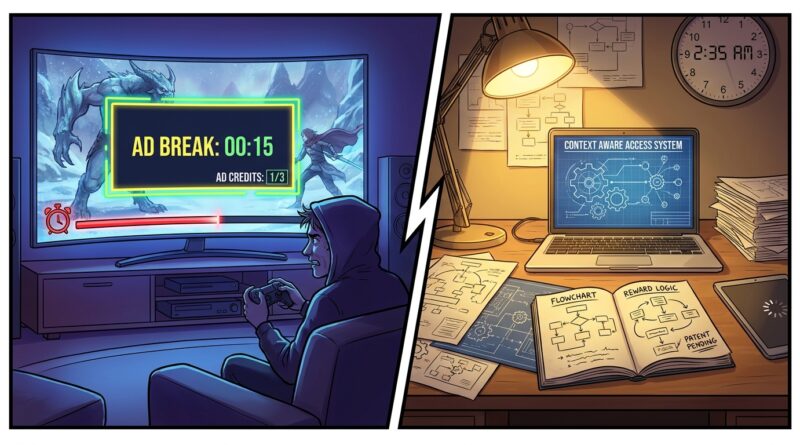
You can spend six months building a clever app, game, or tool, then hit the same ugly question every solo founder hits. How do you make money without annoying the people who gave you a chance? That is why Microsoft’s new patent application matters. Not because gamers are mad, although many are. It matters because US 2026/0260258 A1 shows how a giant company thinks about monetizing attention with surgical precision. The filing describes a system that can spot natural pauses in gameplay, serve an ad, and then hand the player some kind of credit, reward, or gameplay benefit. Most headlines stopped at “Microsoft wants ads in games.” That misses the useful part. If you are an inventor, this is a free lesson in where the patentable idea really lives, how broad companies try to draft protection, and where smaller creators can still carve out safer, smarter ideas of their own.
⚡ In a Hurry? Key Takeaways
- Microsoft’s filing is not just “ads in games.” It focuses on timing ads around gameplay state changes and tying them to player credits or rewards.
- If you are building your own monetization system, start by mapping exactly when attention becomes available, what reward is given, and what makes your logic different.
- You do not need a huge legal budget to file useful IP, but you do need to stay narrow, specific, and careful about claim overlap.
Why this patent has people fired up
Players hate feeling trapped. That is the emotional core of the backlash. If a game freezes, throws up an ad, and makes you wait, it feels less like entertainment and more like a toll booth.
But outrage can hide the more interesting story. Patent filings are not product announcements. They are often defensive. Sometimes they are speculative. Sometimes they are both. A company can patent something it never ships. Still, the filing tells you what the company thinks is worth protecting.
That is the part inventors should care about.
What US 2026/0260258 A1 appears to cover, in plain English
At a high level, the Microsoft in game ads patent US 2026/0260258 A1 for inventors is about serving ads at moments the system sees as less disruptive. Think pauses between levels, loading windows, menus, respawn moments, or other breaks in active play.
Then comes the second piece. The ad is not just shown. The user may get a credit, reward, or other benefit tied to that viewing event. That reward can affect access, progression, or some form of in-game economy.
That mix matters. Lots of people are talking as if “ads in games” is the invention. It usually is not. Patents tend to live or die on the specifics. Timing logic. State detection. Reward assignment. Conditions for interruption. Rules for when the system does or does not trigger.
The likely inventive center
If you strip away the drama, the likely center of the filing is this:
- detect a game context or transition point
- choose a moment that is presented as a natural pause
- serve ad content there
- grant some credit or gameplay-related value after the ad event
That is more concrete than “put an ad in a game,” and that is why it gets interesting from an IP point of view.
What solo inventors should actually read in a patent
If you have ever opened a patent application and felt your eyes glaze over, you are not alone. The trick is not to read it like a novel. Read it like a fence line.
Start with the claims, not the press coverage
The claims are where the legal fight would happen. The abstract and description can be broad and polished, but the claims tell you what the applicant is actually trying to lock down.
When you read a filing like this, ask:
- What exact steps are required?
- What parts seem optional?
- Is the reward required, or just one version?
- Does the system need to detect a “natural pause,” or only any game event?
- Does it require freezing, suspending, or interrupting gameplay?
Those details create the design-around zones.
Look for the independent claims first
Independent claims are the broadest ones. Dependent claims add extra features. If an independent claim says the system detects a transition in gameplay and serves an ad tied to user credit, then a dependent claim might narrow that to a specific kind of reward, device, or trigger.
That means your best chance to build nearby is often outside the independent claim, not just outside one narrow example in the description.
Where the likely design-around zones are
This is the part most small builders need. Not legal advice, of course, but a practical way to think.
1. Different timing logic
If Microsoft’s core idea depends on game-state detection and ad delivery at natural pauses, one design-around path is to use a very different timing model.
Examples:
- user-scheduled ad breaks instead of system-triggered pauses
- session-based rewards given after a completed play period
- ads unlocked only from a voluntary reward center or inventory screen
- time-of-day or streak-based offers not tied to active gameplay state
The key is that your trigger logic should not just be a cosmetic rewrite of the same flow.
2. Different reward logic
If the claim center ties ad viewing to game credit, look at adjacent rewards that are not simple credits.
Examples:
- cosmetic themes in a utility app
- extra analysis reports in a fitness tool
- bonus practice rounds in a learning app
- temporary access to premium filters in a creator tool
Again, details matter. “Reward” is broad in ordinary language, but claims often narrow what counts and how it is issued.
3. Different product category
A lot of solo inventors are not making games at all. They are building focus timers, note apps, habit trackers, tutoring tools, wellness products, or niche mobile utilities. Those products also trade in attention, but the user flow is different.
If your app grants value after a user watches sponsor content during a task handoff, rest period, lesson checkpoint, or progress review, you may be in adjacent territory without copying the same gameplay-centered mechanics.
4. Different consent model
This one is big. If the controversial part of the patent is interruption, then one safer product idea is to make the ad event clearly opt-in.
For example:
- “Watch a 20-second sponsor clip to unlock tomorrow’s report now”
- “Take a sponsor break during cooldown to earn an extra lesson hint”
- “Choose ad-supported mode for lower subscription cost”
That can be better for users and cleaner as a business concept.
What not to copy if you want breathing room
Here is the common mistake. A founder reads about a patent, changes two labels, and assumes they are safe.
That is not how this works.
If your system still does all the same core steps in roughly the same way, with the same trigger and same reward structure, a rename will not help much. Courts and examiners look at substance. So do competitors.
Be especially careful if your product:
- detects a natural interruption point automatically
- pauses or suspends a live user activity
- inserts sponsored content at that point
- gives the user a credit tied to that interruption event
That does not mean “do not build.” It means “build with a map.”
How big companies patent attention systems
This filing is also a reminder that incumbents do not just patent hardware and code tricks. They patent business logic. Flow control. Timing rules. User-state transitions. Monetization mechanics.
For a solo inventor, that can feel unfair. But it is also useful news. It means your clever monetization flow might be more protectable than you think, if it is specific enough and actually new.
What is often patentable in these systems
- the trigger condition
- the sequencing of user actions
- the way rewards are calculated
- the rules that prevent bad timing
- the blend of user context, ad selection, and post-ad benefit
That is good news for builders in health, education, creator tools, productivity, and mobile apps. Attention is not just a gaming issue.
A simple checklist for inventors building ad, reward, or paywall logic
Use this before you write code and before you talk to a patent attorney.
Step 1. Write your flow in one sentence
Example: “When a learner finishes a quiz section, the app offers an optional sponsor clip in exchange for one extra worked example.”
Step 2. Mark the trigger
What starts the monetization event? A pause? A user choice? A threshold? A cooldown? A milestone?
Step 3. Mark the value exchange
What exactly does the user get? Credit, time, access, hints, cosmetics, speed, storage, insights?
Step 4. Mark the user control
Is it forced, suggested, or fully optional? This is not just a product question. It can help define the novelty and the risk profile.
Step 5. Mark the system intelligence
Does your product detect context, behavior, fatigue, progress, or timing quality? That logic may be where the real invention sits.
Step 6. Search for similar claims
Do a basic patent search before you get too attached. You are not trying to become your own lawyer. You are trying to avoid walking blindfolded.
Step 7. Save evidence of your iterations
Keep notes, wireframes, dated diagrams, and prototype records. They help with filings, investor conversations, and product strategy.
Ideas that may be easier to protect without stepping directly into this zone
If you want to file around the broader trend without hugging Microsoft’s logic too closely, think about adjacent systems like these:
- ad-supported cooldown periods in fitness or meditation apps
- optional sponsor unlocks tied to lesson recaps in edtech
- reward logic based on user stress level or task completion quality
- micro-sponsorship systems inside solo creator tools
- paywall bypass tokens earned through non-interruptive attention events
- context-aware ad timing for accessibility-friendly experiences
That last one is especially interesting. A system designed to avoid showing monetized content during cognitively intense, safety-related, or accessibility-sensitive moments could have real value and a clearer user benefit story.
What founders often get wrong about patents
They think the goal is to own a huge category. Usually, it is not. The better goal is to protect the part that makes your version work better, feel better, or earn better.
For solo inventors, a narrow, well-drafted patent can be far more realistic than a grand attempt to own “ads with rewards” across an entire industry.
That is the hidden lesson in the Microsoft in game ads patent US 2026/0260258 A1 for inventors. Big companies file broad, but they still have to anchor those claims to particular mechanics. That leaves room for smart builders who can define a clean lane.
Should you file now or wait?
If your monetization idea is central to your product and not easy to copy, it is worth at least getting a professional opinion sooner rather than later. Public launches, pitch decks, and screenshots can affect your options depending on where you file.
If the idea is still mushy, do not panic-file. First get clear on:
- what your system actually does
- why users would prefer it
- what the machine or app is deciding
- how it differs from standard reward ads or subscription prompts
Specific beats vague every time.
At a Glance: Comparison
| Feature/Aspect | Details | Verdict |
|---|---|---|
| Core patent theme | Context-aware ad insertion during likely natural pauses, tied to credits or rewards | More specific than “ads in games,” which is why inventors should pay attention |
| Best inventor takeaway | Study the claim structure, then build around different triggers, rewards, consent models, or product contexts | Practical path for smaller founders with limited budgets |
| Highest risk area | Copying automatic pause detection plus ad insertion plus user credit in near-identical flow | Avoid lazy clones. Real design-around work matters |
Conclusion
It is easy to look at Microsoft’s freshly published application US 2026/0260258 A1 and stop at the outrage. A giant company patents a system for context-aware in-game advertising, the internet gets mad, and everyone moves on. But if you are an indie founder or solo inventor, that is leaving value on the table. This filing is a real-time lesson in how large companies try to patent business models around attention, where the true inventive concepts often sit in the claim tree, and how smaller creators can still file smart, narrow patents on adjacent reward systems, ad timing logic, paywall alternatives, or user-consent flows. The goal is not to copy Microsoft or panic because a giant got there first. The goal is to read the filing clearly, spot the design-around zones, and define your own lane with enough specificity that it can be protected and monetized. If your product depends on attention in any form, from games to learning or health apps, this debate is not just noise. It is a blueprint.