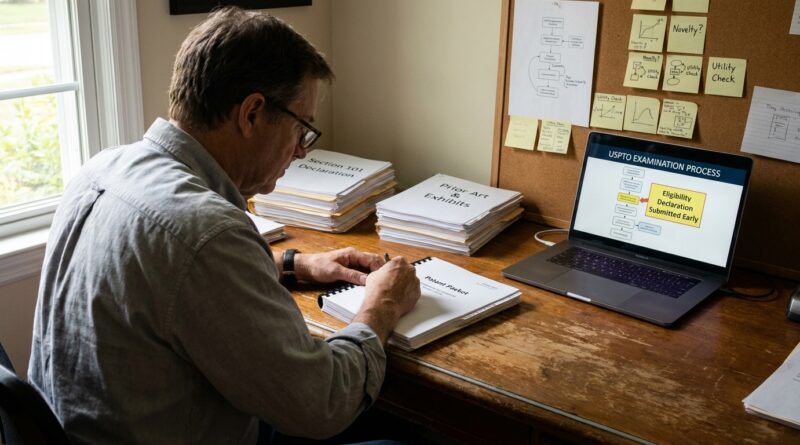
New USPTO 101 Declarations Memo Just Landed: How Solo Inventors Can Use It To Keep Their Patents Alive
Getting a Section 101 rejection can feel like being told, “Your invention is too abstract,” without anyone explaining what that really means. For solo inventors, that is maddening. You spent months building, sketching, testing, and filing, only to get language that sounds slippery and hard to fight. Now the USPTO has put fresh attention on subject matter eligibility declarations, and the practical takeaway is bigger than it looks. If you think a declaration might help show that your invention solves a real technical problem, the Office is signaling that timing and packaging matter. In plain English, do not wait until late in prosecution if you can avoid it. And do not bury a useful declaration inside a pile of other papers. For first-time filers, this is one of those small process shifts that can make a response look clearer, more serious, and easier for an examiner to act on.
⚡ In a Hurry? Key Takeaways
- A Section 101 declaration can help if it gives concrete facts showing your invention improves technology, not just an idea on paper.
- File a useful declaration early, and separately from unrelated response materials, so the examiner sees it and can address it directly.
- A declaration is not magic. It works best when your claims and specification already describe a specific technical solution.
What just changed, in normal-person terms
The new USPTO memo does not rewrite patent law. It does something more practical. It tells examiners and applicants what the Office sees as best practices for Section 101 declarations.
That matters because a lot of inventors treat declarations like a last-ditch add-on. The new guidance suggests they may be more effective when submitted earlier and in a cleaner, more focused way. In other words, if you have real-world facts that support eligibility, bring them forward sooner.
This is especially important for solo inventors because you usually do not have a big law firm steering the timing. If you miss the moment when a declaration could shape the examiner’s first serious look at your case, you may spend months trying to undo a bad first impression.
First, what is a Section 101 declaration?
It is a signed statement, usually from the inventor or a qualified expert, that gives factual support for why the claimed invention is patent-eligible.
Its job is not to argue law like a lawyer would. Its job is to provide facts. For example:
- What technical problem existed before your invention
- How prior systems handled that problem badly or not at all
- What specific technical steps your invention uses
- What improvement those steps produce in the real world
- Why the improvement is not just “do it on a computer”
Think of it as sworn backup for your story. You are not just saying, “This is innovative.” You are saying, “Here are the facts showing this solves a technical problem in a concrete way.”
Why the memo matters so much for solo inventors
Large companies often have prosecution playbooks. They already know when to use declarations, who should sign them, and how to line them up with claim amendments. Solo inventors often learn about these tactics after getting stuck.
That is why this memo is urgent. It quietly changes first-response strategy. If examiners start expecting stronger factual records earlier, small filers who wait too long may lose momentum fast.
The good news is that this is fixable. You do not need a legal department. You need a checklist and a little discipline.
When a declaration can actually help
A declaration is most helpful when the examiner says your claims are directed to an abstract idea, and your best answer depends on facts, not just legal wording.
Good situations for using one
- Your invention improves computer performance, network reliability, security, image processing, sensor accuracy, or another technical function.
- Your invention fixes a known technical bottleneck.
- The claims may sound high-level at first glance, but the actual implementation is specific and technical.
- The examiner seems to be treating your invention like generic software when it is more than that.
Weak situations for using one
- Your claims are written so broadly that they really do read like a business idea or mental process.
- Your specification barely explains the technical mechanism.
- The declaration just repeats legal conclusions like “this is not abstract” without facts.
This is the hard truth. A declaration cannot rescue claims that are too vague. It can support a strong application, but it cannot invent technical detail that is not already there.
What the USPTO seems to want from these declarations
Based on the Office’s recent emphasis, a useful declaration should be focused, factual, and easy to connect to the claims.
That means:
- Explain the technical problem clearly.
- Map the facts to actual claim elements.
- Describe the improvement in specific terms.
- Avoid buzzwords and chest-thumping.
- Keep legal argument in your response brief, not in every sentence of the declaration.
The examiner should be able to read it and think, “I see the factual point. I know what this invention does differently.”
The new practical lesson: file earlier and file separately
This may be the most useful part for inventors handling their own strategy.
Earlier
If you already know a 101 fight is likely, do not assume you should wait until things get ugly. A good declaration filed with the first serious response can shape the record before the case hardens into back-and-forth boilerplate.
Separately
If possible, do not bury the declaration in a messy package full of unrelated papers, IDS filings, and procedural odds and ends. Give it a clear label. Mention it directly in your response. Make it easy to find.
This sounds minor. It is not. Examiners are busy. If your key evidence is hidden, it is weaker in practice even if it is technically in the file.
A simple response strategy for first-time inventors
If you receive a 101 rejection, start here.
Step 1: Read the rejection for the examiner’s real complaint
Do not just react to the words “abstract idea.” Ask what the examiner thinks is abstract. Is it data collection? Organizing information? A business rule? A mental process?
Step 2: Identify your technical hook
What does your invention improve, in a nuts-and-bolts sense? Speed? Accuracy? Security? Memory use? Device control? Signal quality?
Step 3: Check whether your specification supports that hook
If your original filing explains the technical problem and your solution, good. If not, your options are narrower.
Step 4: Decide whether a declaration adds facts the examiner may not appreciate from the application alone
A declaration is useful when it highlights context, industry practice, prior shortcomings, or technical impact.
Step 5: Keep the declaration factual and the legal argument separate
Your response can say why the law favors eligibility. The declaration should say what is true, what was known, and what changed because of your invention.
Template outline you can use this week
Here is a plain-English structure for a Section 101 declaration. This is not legal advice, but it is a practical starting point for discussing a draft with counsel or organizing your own materials.
Basic declaration structure
- Who I am. State your name, role, and technical background.
- What I know. Explain your involvement with the invention and the field.
- The technical problem. Describe the specific technical issue that existed before the invention.
- The prior approach. Explain how existing systems handled the issue and where they fell short.
- The claimed solution. Point to the claim features that address the problem.
- The technical improvement. Describe the concrete improvement produced by those features.
- Why this is not generic computer use. Explain why the solution depends on more than ordinary use of standard components.
- Statement of truth. Close with the usual declaration language required for USPTO filings.
Sample wording for the middle section
“Before the invention, systems that processed sensor input in this environment often produced delayed alerts because they analyzed readings in a fixed sequence and rechecked stable values too often. The claimed method improves this by dynamically prioritizing sensor streams based on variance thresholds and event probability. In practice, this reduces processing load and shortens alert time during unstable conditions.”
Notice what this does right. It talks about a technical problem, a technical mechanism, and a measurable type of improvement. It does not just say “my invention is innovative.”
Mistakes that hurt more than they help
1. Writing a declaration like a sales pitch
Words like “revolutionary” and “groundbreaking” do not help much. Facts do.
2. Copying the legal standard without adding evidence
Saying the invention is “significantly more” than an abstract idea is not useful by itself. Show why.
3. Ignoring the claims
If the declaration talks only about the product in broad terms, but not the claimed features, the examiner can dismiss it as off-point.
4. Waiting too long
The fresh USPTO emphasis makes delay riskier. Earlier is often better.
5. Letting the declaration contradict the application
If your declaration introduces ideas not supported by the original filing, it may do more harm than good.
Example: weak vs. stronger declaration language
Weak
“The invention is not abstract because it uses a computer to improve business efficiency and provides better results for users.”
Stronger
“The claimed method does not simply automate a human review process. It uses a rule-driven packet classification sequence that changes processing order based on detected error signatures. This reduces retransmission events and lowers bandwidth waste in high-noise conditions.”
The second version gives the examiner something concrete to evaluate.
Do you need an expert, or can the inventor sign?
Sometimes the inventor is enough, especially if you can credibly explain the technical field and the problem solved. In tougher software or engineering cases, an outside expert may carry more weight.
But do not assume “expert” automatically means “better.” The best declarant is the one who can clearly and truthfully explain the technical facts and tie them to the claims.
How to package the filing so it gets noticed
- Give the document a clear title, such as “Declaration Under 37 C.F.R. § 1.132 Regarding Subject Matter Eligibility.”
- Mention it early in your response, not in a footnote.
- Add a short roadmap in the response explaining what factual points the declaration supports.
- Where possible, cite paragraph numbers from the declaration when discussing eligibility.
- Do not mix it into unrelated filings without explanation.
You are trying to reduce friction for the examiner. The easier it is to follow, the better your odds that it gets real attention.
One more reality check
If your claims are still drafted at a very high level, the best move may be a combination of claim amendment plus declaration. The declaration supports the story. The claims still need to say something specific.
This is where solo inventors often get trapped. They hope evidence alone will fix claim language that is too broad. Usually it will not.
At a Glance: Comparison
| Feature/Aspect | Details | Verdict |
|---|---|---|
| Timing of declaration | Filed with the first strong response to a 101 rejection, instead of waiting until later rounds | Usually smarter for solo inventors |
| Content quality | Specific technical facts tied to claim elements, not broad legal conclusions | High value if your application supports it |
| Filing format | Submitted clearly and separately, with direct references in the response | Worth doing because visibility matters |
Conclusion
The big takeaway is simple. The USPTO’s new attention to Section 101 declaration best practices means solo inventors should stop thinking of declarations as late-stage cleanup tools. If a declaration can show that your invention solves a real technical problem in a specific way, bring that support earlier and present it clearly. That shift matters now because examiners may increasingly expect a cleaner factual record up front, and small filers are usually the ones caught off guard. You do not need to panic, but you do need a plan. Read the rejection closely, find the technical heart of your invention, match it to the claims, and if a declaration makes sense, file it in a way that is easy to notice and easy to use. Done right, this week’s confusing memo becomes a practical checklist, and that can help keep a promising patent application from sinking into the mud.