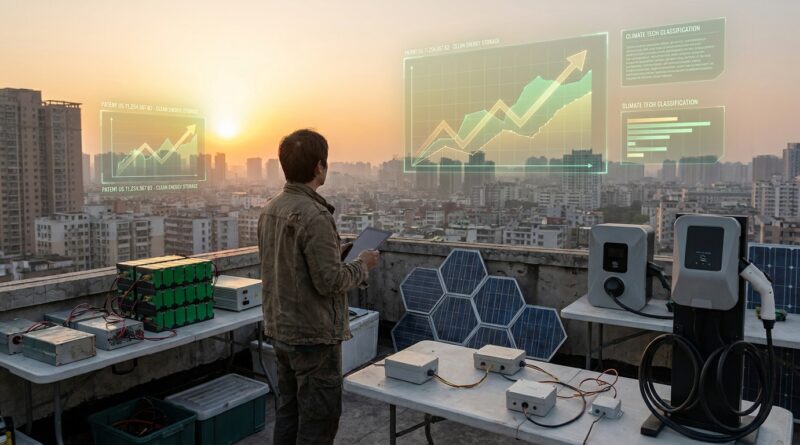
Green Tech Patents Are Quietly Surging Again: How Solo Inventors Can Ride The Climate Wave Instead Of Chasing AI Hype
It is easy to feel late right now. Every pitch deck screams AI, every founder thread sounds the same, and if your idea involves heat pumps, water reuse, insulation, batteries, grid hardware, or waste reduction, you can start to think the gold rush already passed you by. That is the frustrating part. A lot of solo inventors assume green tech is owned by giant utilities, automakers, and government labs. But the patent picture is more interesting than that.
Green tech patent filing trends for solo inventors are quietly improving in several corners of climate tech, especially where products solve boring, expensive problems for buildings, small industry, farms, fleets, and local infrastructure. The surge is not broad and simple. Some areas are crowded and brutal. Others are growing but still thin enough for a focused inventor to carve out a useful claim set. If you stop chasing generic AI tools and start looking at where regulation, subsidies, insurance pressure, and corporate reporting rules are pushing buyers, you can find real openings that do not require a billion-dollar lab.
⚡ In a Hurry? Key Takeaways
- Yes, green patents are rising again, but the best openings for solo inventors are in overlooked climate problems, not headline-grabbing moonshots.
- Start with a compliance or cost pain point in buildings, water, waste, energy efficiency, or small-scale electrification, then search for narrow patent gaps.
- Be careful in crowded zones like core battery chemistry and broad carbon capture claims, where filing costs and competition can bury small players fast.
Why green tech feels smaller than it really is
Climate tech often gets talked about like one giant category. It is not. It is a mix of very different markets. Some are science-heavy and capital-hungry. Others are practical and messy. Think leak detection, thermal management, building retrofits, charging accessories, refrigerant handling, agricultural water use, local storage controls, and material recovery.
That matters because solo inventors rarely win by trying to outspend major labs. They win by spotting a pain point that large companies ignore because it looks too narrow at first.
Big firms love huge platform stories. Small inventors can do better with a product that helps a warehouse lower HVAC waste by 12 percent, or helps a small factory recover low-grade heat, or helps a property owner document energy savings for rebates and insurance.
What the patent trend is really saying
The return of climate-focused patent activity is tied to something simple. Money is following rules. Governments are pushing efficiency standards, emissions targets, grid upgrades, domestic manufacturing, electrification incentives, and reporting requirements. Big companies are also being pushed by customers, lenders, and procurement teams to show measurable sustainability work.
When rules change, patent filings tend to follow. Not always instantly, but consistently. Inventors file where buyers will soon be forced to spend.
That is the heart of green tech patent filing trends for solo inventors. The opportunity is less about saving the planet in a vague way and more about helping somebody comply, cut costs, reduce downtime, win incentives, or avoid future penalties.
Where solo inventors still have a shot
1. Building efficiency and retrofit hardware
This is one of the least glamorous and most practical places to look. Buildings waste huge amounts of energy, and many existing properties cannot do full rip-and-replace upgrades.
That creates room for inventions like:
- Retrofit airflow control parts
- Window or facade add-ons that improve insulation without full replacement
- Low-cost occupancy and thermal balancing systems
- Heat recovery attachments for existing equipment
- Sensor housings and installation systems that make old buildings easier to monitor
These ideas do not sound flashy. Good. Flashy usually means crowded.
2. Water efficiency, treatment, and monitoring
Water tech is often overlooked by software-first founders, which helps solo inventors. Cities, farms, industrial sites, and commercial buildings all face rising pressure to detect leaks, reuse water, lower contamination risk, and document compliance.
Look for narrow inventions around:
- Point-of-use filtration improvements
- Modular greywater handling
- Leak isolation devices
- Low-power remote sensors
- Maintenance-friendly cartridge or membrane designs
If your idea saves labor, shortens service time, or reduces false alarms, it may have stronger commercial value than a grand technical concept.
3. Waste sorting, recovery, and material reuse
There is still room here because many waste streams are ugly, inconsistent, and local. Large tech firms tend to prefer neat markets. Waste is rarely neat.
Solo inventors can find space in:
- Mechanical sorting attachments
- Safer handling tools for e-waste or hazardous streams
- Small-scale plastics separation systems
- Packaging recovery designs
- Repairability-focused product components
Do not assume the invention has to be revolutionary. If it reduces contamination in a recycling line or makes reuse easier, that may be enough.
4. Grid edge tools and small-scale electrification
This area is broad, but parts of it are still open. You are not likely to dominate utility-scale infrastructure alone. But you may find room in the edges. Charging accessories, load management devices, enclosure designs, cooling methods, maintenance tools, and small control systems can all matter.
If your work touches batteries, read the competitive signals carefully. The core chemistry race is intense. This is where Battery Patent Wars Just Escalated: How Solo Inventors Can Read The Signals Before Big Auto Locks Up The Grid is useful. It shows how quickly big auto and energy players can fence off major battery territory. For solo inventors, battery-adjacent hardware is often safer than going straight at the chemistry giants.
5. Refrigeration, cooling, and heat reuse
Cooling is becoming a bigger climate and business issue at the same time. Food storage, transport, buildings, data centers, and industrial processes all care about heat. New refrigerant rules also create openings.
Promising angles include:
- Efficiency parts for existing cooling systems
- Leak detection and containment
- Compact heat exchangers
- Waste heat capture for smaller facilities
- Maintenance and retrofit tools for newer refrigerant standards
This is the kind of category where a clever attachment or service-friendly design can be more patentable and more sellable than a giant end-to-end system.
Where solo inventors should be careful
Carbon capture broad claims
Carbon capture gets attention, but broad claims here are often expensive to defend and hard to commercialize without major capital. If you work in this area, focus on a narrow subsystem, maintenance issue, material handling problem, or measurement tool.
Core battery chemistry
This is still a high-stakes zone. A small inventor can contribute, but the risk is obvious. Prior art is dense. Corporate filing volume is high. Testing costs can be painful. Battery pack safety, charging connectors, thermal controls, and recycling systems may offer better odds.
Anything that sounds too universal
If your draft claim reads like it could apply to every building, every vehicle, or every grid system, it is probably too broad and likely to hit prior art. Narrow is not weakness. Narrow can be your moat.
How to spot an actual opening instead of a nice-sounding idea
Start with forced demand
Look for spending that will happen even in a weak economy. That usually means regulation, insurance pressure, utility rebates, procurement standards, or operating cost cuts.
Ask:
- Who will be pushed to buy this in the next 2 to 5 years?
- What new rule or cost trend makes this urgent?
- Can the buyer explain the savings or compliance benefit in one sentence?
Search patent clusters, not just keywords
Many inventors search one phrase, get overwhelmed, and quit. Better approach. Search by problem, component, install method, maintenance need, and user environment.
For example, do not just search “energy efficiency device.” Search combinations like:
- retrofit damper commercial rooftop unit
- greywater modular valve apartment building
- thermal enclosure EV charger outdoor
- refrigerant leak detection service manifold
You are trying to find claim gaps around practical use, not just broad technical themes.
Study what big players ignore
Large firms often leave awkward market segments alone. Older buildings. Rural installs. Multi-tenant retrofits. Harsh environments. Low-maintenance systems. Low-cost compliance reporting. These can be perfect places for a solo inventor because the users still have real pain.
A simple filter for green tech patent ideas
Before you file, run your idea through this quick test:
- Does it solve a climate-linked cost or compliance problem?
- Can one buyer type be named clearly?
- Is there a specific hardware, method, or system feature that is new?
- Can you build or mock up enough to explain the use case?
- Is the patent scope narrow enough to survive prior art, but broad enough to matter?
If you cannot answer yes to most of these, the idea may still be useful, but it is not ready for a filing strategy.
Why chasing AI may actually hurt some inventors
This does not mean AI is useless. It can help with analysis, monitoring, forecasting, and control. But many inventors are slapping AI onto weak ideas because it feels current.
That creates two problems. First, generic AI claims are becoming common and hard to defend. Second, buyers in climate markets often care more about reliability, installation speed, safety, and compliance than fancy software.
If you have a green hardware idea, adding software later is fine. But the real value may be in the valve, housing, mounting system, thermal path, recovery process, or retrofit method itself.
Practical next steps for a solo inventor
Pick one climate pain point you already understand
Do not start with “climate tech.” Start with a real annoyance you have seen in a building, shop, fleet, farm, warehouse, or utility setting.
Map the buyer pressure
Find out whether this buyer is being pushed by energy costs, water rules, refrigerant rules, emissions reporting, resilience planning, insurance, or labor shortages.
Search for adjacent patents
Look at what already exists. Then ask what they missed. Too expensive? Too hard to install? Too complex to maintain? Not suited for older equipment?
Write the invention around the missed detail
This is how small inventors get traction. Not by inventing the entire future, but by solving one stubborn bottleneck well.
Talk to users before filing too wide
A few buyer calls can save you months. You may learn that your “main” feature is less important than a side benefit like easier cleaning, faster installation, or lower false alarm rates.
At a Glance: Comparison
| Feature/Aspect | Details | Verdict |
|---|---|---|
| Best green patent zones for solo inventors | Building retrofits, water systems, waste recovery, cooling efficiency, battery-adjacent hardware, and grid edge tools | Strong if tied to a clear buyer pain and narrow claim set |
| Most crowded or risky areas | Core battery chemistry, broad carbon capture concepts, vague AI-plus-climate software claims | Proceed carefully and narrow your target |
| Best strategy for filing | Focus on a compliance, retrofit, maintenance, or cost-saving problem that big firms treat as too small | Most practical path for a solo inventor |
Conclusion
Green tech is not closed off. It is just uneven. That is the part many solo inventors miss. Climate-related patent activity is rising again, but not every corner is worth your time, and some of the loudest areas are the worst traps for a one-person shop. The smarter move is to look for expanding patent clusters where buyers are being pushed by regulation, subsidies, energy costs, water stress, insurance demands, and sustainability reporting. That is where a practical inventor can still matter. If this helps more people pivot an existing hardware idea, or spot a new one in buildings, cooling, water, waste, or grid edge systems, then the community benefits right now. You do not need to chase another generic AI agent. You need a real problem, a clear buyer, and a patent angle big players have not bothered to clean up yet.