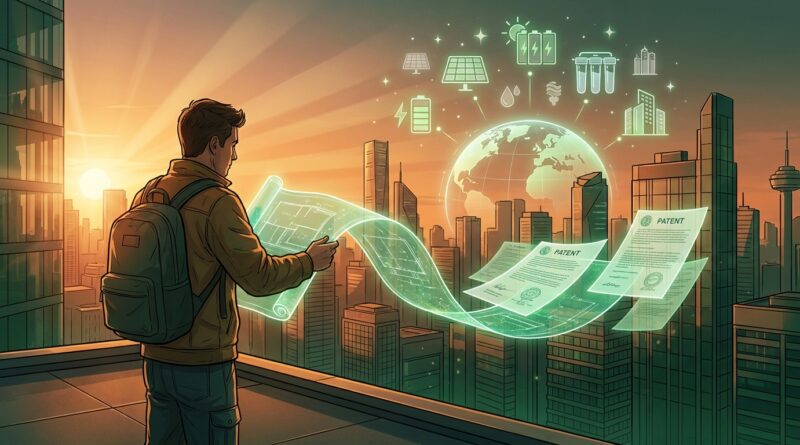
Green Tech Patents Just Hit a Record High: How Solo Inventors Can Turn Climate Anxiety Into IP Assets
It is hard not to feel shut out when you read about record climate tech patents. You see giant energy firms, government-backed labs, and venture-funded startups filing at full speed, and it is easy to think, “Well, that is not for people like me.” That frustration is real. But the latest WIPO numbers tell a more useful story too. Global patent and design filings hit fresh highs in 2024, and many of the busiest areas connect directly to sustainability, efficiency, software, and practical problem-solving. That matters because solo inventors do not need to invent a fusion reactor to join in. A smarter battery cooling bracket, a better food-waste sorter, a flood-sensor housing that is cheaper to maintain, these are the kinds of ideas that can become real IP assets. If you have been watching green technology patent filing trends 2026 and wondering whether the door is closing, it may actually be opening for people who can define a clear problem and describe a useful fix.
⚡ In a Hurry? Key Takeaways
- Record green and sustainability-linked patent activity does not mean solo inventors are too late. It means the market is paying attention.
- Start with one narrow climate problem, document your fix, and shape it into a patentable system, method, device, or process.
- Do not file on hope alone. Check prior art, define what is actually new, and match your invention to real buyers, grant makers, or licensing paths.
Why this patent surge should not scare you
Big filing numbers can feel like bad news. More competition. More lawyers. More noise. But a filing boom also means something else. It means patent offices, investors, and public funding programs are already looking in this direction.
That is useful for a solo inventor. You are not trying to create demand from scratch. You are stepping into a category the world already thinks is important.
WIPO’s latest data shows global filings rising again, with computer technology among the top areas and sustainability-linked innovation gaining momentum. That mix is especially good news for independent inventors because many climate solutions are not massive hardware moonshots. They are often combinations of software, sensors, controls, materials, packaging, energy savings, waste reduction, and resilience planning.
In plain English, a climate invention can be small and still matter.
What counts as a “green” patent idea for a solo inventor?
Many people disqualify themselves too early. They assume a green invention must be a brand-new solar panel chemistry or a grid-scale battery breakthrough. Usually, that is not the best place for one person to start.
A stronger starting point is this question. What everyday system wastes energy, materials, water, labor, or time, and how could you improve it in a measurable way?
Good solo-inventor examples
You might have an idea for:
- A device that cuts water use in small farms or home irrigation
- A better way to sort or compact recyclable material
- A low-cost retrofit that improves insulation or cooling efficiency
- A sensor-based alert system for leaks, heat stress, mold, smoke, or flood risk
- A packaging design that reduces waste and is easier to reuse
- A repair-friendly component that extends the life of tools, batteries, or appliances
That is where many promising patent projects begin. Not with “save the planet” as a slogan, but with “this thing wastes too much, breaks too often, or costs too much to maintain.”
How to turn climate anxiety into an IP asset
Climate anxiety is often just concern with nowhere to go. A patent project gives it a direction. It turns vague worry into a specific problem statement, a testable fix, and potentially a business asset.
Step 1: Name the exact pain point
Skip broad phrases like “reduce emissions” at first. Get specific. Try something more like, “Apartment buildings lose cooled air because older window seals are hard to inspect and replace cheaply,” or “Small restaurants throw out compostable waste bags because current liners tear under heat and moisture.”
If you can describe the user, the setting, and the failure clearly, you are already ahead of many idea-stage inventors.
Step 2: Describe your fix like a system
Patentable ideas are often clearer when framed as a system, method, apparatus, composition, or design.
For example:
- System: a sensor plus app plus alert logic for flood-prone homes
- Method: a new sequence for separating mixed household plastics
- Apparatus: a clip-on cooling attachment for outdoor battery cabinets
- Design: a container shape that stacks, drains, or reuses better
This helps move your idea from “I have a thought” to “I can explain what the invention is.”
Step 3: Look for what is actually new
This part matters. A patent is not a prize for having a good intention. It is about novelty, and often non-obviousness too.
Search existing patents, published applications, product listings, manuals, white papers, and technical forums. You are not trying to prove no similar thing exists anywhere. You are trying to find the gap. Maybe your invention uses a different mechanism, lower-cost material, smarter control logic, easier maintenance layout, or a new combination of old parts.
If you want a good reality check on how solo inventors can think about this space without getting buried in policy talk, this earlier guide is worth a read: Clean Tech Patents Are Surging Again: How Solo Inventors Can Surf The New Green Wave Without Drowning In Policy Jargon.
Step 4: Collect proof, even if it is simple
You do not need a giant lab. But you do need evidence. Sketches help. Photos help. A rough prototype helps more. Test notes are even better.
Can you show that your design reduces waste, improves durability, lowers energy use, simplifies installation, or cuts replacement cost? Even early proof can strengthen your filing strategy and later conversations with partners or funders.
What WIPO filing records mean for green technology patent filing trends 2026
When people search for green technology patent filing trends 2026, they are usually asking a hidden question. Is this still growing, or will I be too late?
The better answer is that patent momentum tends to build in waves. Record filings in 2024 suggest that 2026 will likely keep rewarding inventions tied to software, energy efficiency, smart infrastructure, circular economy systems, low-waste manufacturing, and climate resilience.
That does not mean every green pitch wins. It means the language of sustainability is now linked to real filing behavior, real capital, and real policy interest.
So if you are building now, you are not arriving after the party. You are arriving when the category is still being shaped.
Where solo inventors usually get stuck
Most independent inventors do not fail because they lack ideas. They get stuck in one of four places.
1. They stay too broad
“A better recycling system” is too vague. “A compact countertop sorter that separates wet organics from dry packaging using a removable dual-chamber funnel and odor-reducing liner” is getting useful.
2. They confuse a mission with an invention
“Helping cities become greener” is a mission. A patent needs a concrete technical solution.
3. They ignore the buyer
Your invention may be clever, but who pays for it? Homeowners? Municipal waste contractors? Building managers? Insurers? Farmers? Grant-funded nonprofits? Knowing this early helps shape both the patent and the pitch.
4. They file too thin
A rushed filing that barely explains the invention can become an expensive lesson. Even a provisional filing should clearly describe variations, parts, use cases, and what makes the invention different.
Simple ways to make a green patent project more fundable
Fundable does not always mean venture capital. It can mean a grant, pilot partner, angel investor, licensing interest, or a paid trial. The point is to make your invention legible to people with money.
Use numbers where possible
Try to estimate:
- Energy saved
- Material waste reduced
- Water saved
- Maintenance time cut
- Replacement cycles extended
- Cost per unit or install
Even rough numbers are better than empty claims.
Frame the invention around adoption
Ask yourself:
- Does this require people to change habits, or can it fit into what they already do?
- Is it a retrofit, or does it require full replacement?
- Can it be manufactured simply?
- Does it need regulation approval?
- Can it be licensed to an existing company?
The easier the path to use, the more attractive the IP often becomes.
Write claims for the real-world version, not just the dream version
Many solo inventors focus on the best-case prototype. Smarter filings also cover practical variants. Different materials. Alternate sensor types. Manual and automated versions. Indoor and outdoor use. Low-cost and premium versions.
This gives your patent strategy more room to grow.
You do not need to beat big companies. You need a defined edge.
This is the part people miss. You are not competing head-to-head with every multinational filing in climate tech. You are trying to carve out one protectable improvement in one problem area.
Maybe a giant company has broad coverage in battery management. That does not automatically block a smaller, very specific invention related to mounting, thermal shielding, maintenance access, diagnostics, recycling, or safe storage.
Patent strategy is often about finding the overlooked corner where your idea is both useful and distinct.
A practical starter checklist
If you want to move this from worry to action, start here:
- Write a one-sentence problem statement
- Write a one-sentence invention statement
- Sketch the invention from three angles
- List 3 to 5 features that are essential
- List 3 alternative versions
- Search patents and products in the same area
- Note what your idea does differently
- Identify the likely buyer or licensing target
- Collect any early test data or observations
- Decide whether to prepare a provisional filing or talk to a patent professional first
That is not glamorous. It is effective.
At a Glance: Comparison
| Feature/Aspect | Details | Verdict |
|---|---|---|
| Patent surge in green tech | WIPO data shows record filings, with sustainability-linked and tech-heavy categories staying active | Good sign for solo inventors if you pick a focused niche |
| Best solo inventor entry point | Practical improvements in efficiency, waste reduction, resilience, monitoring, or repairability | Much more realistic than chasing giant breakthrough categories |
| What makes the idea valuable | Clear novelty, proof of usefulness, and a believable path to adoption or licensing | Strongest route to turning climate concern into a real IP asset |
Conclusion
The headline number matters, but not for the reason many people think. Record patent and design filings in 2024 are not just proof that large institutions are busy. They are a signal about what the world is willing to reward. Computer technology and sustainability-driven fields are leading the charge, and that creates room for solo inventors who can define a real problem and propose a clear fix. For the Patentop community, this is the moment to stop doom-scrolling climate news and start shaping even small, practical ideas into patent language that offices, partners, and climate funds understand. You do not need a moonshot. You need a useful, well-described invention with a reason to exist. That is how you move from “someone should fix this” to a concrete, fundable patent project.