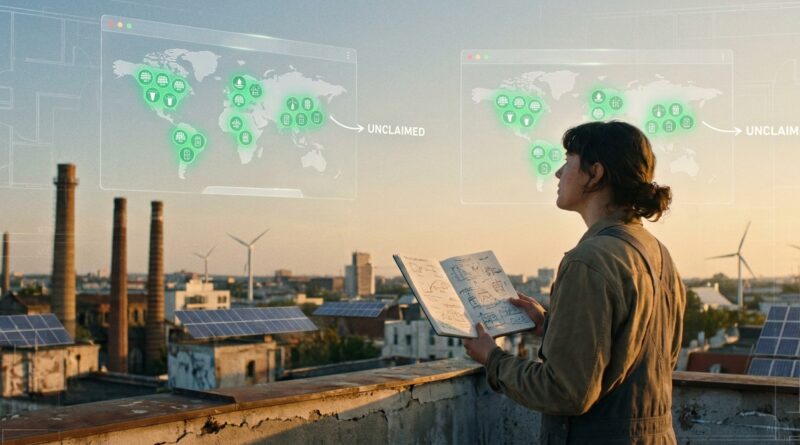
Clean Tech Patents Are Surging Again: How Solo Inventors Can Surf The New Green Wave Without Drowning In Policy Jargon
If you are a solo inventor, the clean tech boom can feel oddly discouraging. You read that climate patents are climbing again, then you open a database and see page after page of filings from utilities, automakers, chemical giants, and giant research teams. It is easy to think the door is closed. It is not. The trick is to stop reading those filings as a scoreboard and start reading them as a map. Big companies usually patent where regulation, public money, and painful real-world bottlenecks are about to collide. That gives smaller inventors a clue about where demand is forming. For anyone tracking clean tech patent trends 2026 for independent inventors, the smartest move is not chasing massive battery plants or new solar chemistries from scratch. It is finding the smaller, under-served problems around them. Think local grid resilience, water stress, waste heat reuse, retrofit sensors, and cheap efficiency tools for small facilities. Those are often messy, urgent, and still open enough for one determined person to matter.
⚡ In a Hurry? Key Takeaways
- Clean tech patent growth helps solo inventors most when used as a clue to unmet local problems, not as a sign to copy big-company filing habits.
- Start with one specific pain point tied to public funding or regulation, then check patent clusters and local buyers before writing a patent draft.
- A “green” idea is not enough. The best solo inventions are practical, testable, safe to deploy, and easy for a city, plant, or manufacturer to license.
Why the surge looks bigger than your chance, and why that is misleading
The headlines are true. Clean tech filings are hot again. But headlines flatten everything. They mix giant utility-scale systems with niche sensors, industrial controls, recycling methods, thermal management tricks, and water treatment hardware.
That matters because solo inventors usually do not win by outspending a multinational on a moonshot. They win by spotting the annoying little problem that keeps delaying adoption, raising operating costs, or making compliance harder than it should be.
A new transmission project may be out of reach. A cheap way to detect overheating in older neighborhood transformers might not be. A revolutionary desalination platform may be too big. A retrofit cartridge that cuts fouling in small municipal systems could be realistic.
The market is not one big green blob. It is a pile of bottlenecks.
How to read clean tech patent trends like a solo inventor
Patent databases can look like alphabet soup. Start simpler. You are not trying to become a policy analyst. You are trying to answer three plain-English questions.
1. Where is money about to be spent?
Look for grants, state procurement notices, resilience plans, utility pilot programs, EPA or DOE program summaries, and local climate adaptation budgets. If public agencies are openly saying, “We need better monitoring, lower waste, cleaner processing, or cheaper backup capacity,” that is a useful signal.
2. What problem keeps showing up next to that money?
Not the broad mission. The repeated headache. Things like corrosion, downtime, maintenance cost, difficult retrofits, shortage of skilled operators, contaminated inputs, heat loss, or bad sensor reliability.
3. Is the patent space crowded at the top but thin around the edges?
This is often where solo inventors can still fit. The main system may be packed with filings, while peripheral tools are oddly open. Search by problem, not just by buzzword. “Waste heat exchanger anti-fouling,” “low-cost leak detection industrial steam,” or “small facility peak shaving controller” will usually teach you more than just searching “climate tech.”
The four zones where solo inventors may still have room
Local grid resilience
Utilities get most of the attention, but local resilience is full of practical gaps. Backup switching, fault detection, transformer monitoring, low-cost load prioritization, microgrid controls for small campuses, weatherproof housings, and simpler installation hardware all matter.
The key here is retrofit reality. A city, school district, or small cooperative often needs something that works with aging infrastructure and limited staff.
Water stress
Water is becoming a bigger clean-tech story because drought, contamination, pumping costs, and industrial reuse are all colliding. Good solo-inventor targets include low-maintenance sensors, anti-clog components, compact filtration modules, leak detection, cleaning systems, or energy-saving controls for pumps and treatment units.
If your idea saves water and electricity at the same time, buyers listen more carefully.
Waste heat reuse
This area is less glamorous than batteries, which is exactly why it can be interesting. Small factories, commercial kitchens, laundries, food processors, and workshops throw off heat constantly. Capturing, storing, redirecting, or measuring that heat is often a game of practical engineering, not giant science budgets.
If you can make heat recovery cheaper, easier to install, or less annoying to maintain, you may have something that is both patentable and licensable.
Small-scale industrial efficiency
Many climate targets depend on thousands of small and midsize facilities shaving waste, not on one giant flagship plant. Think compressed air losses, steam leaks, motor controls, boiler tuning, insulation attachments, contamination monitoring, and software-assisted maintenance tools tied to hardware.
This category is especially promising because buyers often care more about payback period than fancy branding.
A practical research workflow that will not eat your whole month
Here is a useful sequence for clean tech patent trends 2026 for independent inventors.
Step 1. Pick one local pain point
Not “decarbonizing industry.” Too broad. Pick “small food processors lose money from low-grade waste heat venting” or “older municipal pump stations lack cheap predictive maintenance sensors.”
Step 2. Find who is already complaining about it
Look at trade associations, local government plans, utility commission documents, engineering conference abstracts, and public RFPs. If people are repeatedly describing the same issue, you have evidence of demand.
Step 3. Scan recent patent clusters
Search Google Patents, Espacenet, and WIPO Patentscope. Focus on the last three to five years. Read titles and abstracts first. You are looking for patterns:
- What approaches are everyone else trying?
- What assumptions do those inventions make?
- What use case is being ignored?
- Are claims broad, or are they surprisingly narrow?
Step 4. Build a saturation check
If you find hundreds of filings all attacking the exact same mechanism in the exact same deployment setting, be careful. If you find broad activity around the sector but little aimed at your specific use case, that is better.
Step 5. Talk to one buyer, operator, or maintainer
This step saves people from filing patents nobody wants. Ask what fails most often, what is too expensive, what takes too long to install, and what they would never buy because of training or maintenance headaches.
Step 6. Write your invention around the real constraint
Your strongest patent angle may not be the core device. It may be the mounting method, the calibration process, the cleaning cycle, the control logic, the serviceability, or the way your system handles ugly real-world conditions.
What makes a clean tech patent fundable instead of just “green sounding”
Investors, grant reviewers, and licensing teams all say they want innovation. In practice, they also want a believable path to use.
Your application gets stronger when it clearly shows:
- A defined customer or deployment setting
- A measurable benefit like lower energy use, lower water loss, lower maintenance, or lower downtime
- A practical installation path
- Evidence that the problem is current, not theoretical
- A claim scope that protects the useful part without drifting into fantasy
This is where many independent inventors go off track. They write as if “helps the planet” is enough. It is not. Buyers sign checks for savings, compliance, uptime, safety, and easier operations.
Do not confuse policy language with market proof
Climate policy documents are useful. They are just not customer interviews. A net-zero roadmap may tell you which sectors matter. It will not tell you whether a wastewater operator has five minutes to maintain your device or whether a plant manager can install it without shutting down a line.
Use policy as a direction finder. Use field reality to shape the invention.
The same basic lesson shows up in other rising sectors too. If you liked our piece on Biodefense Patents Are Quietly Surging: How Kitchen‑Table Inventors Can Spot Safe Gaps In The New Biosecurity Rules, the pattern will feel familiar. Big headlines and new rules can make solo inventors feel locked out, when the real opening is usually in safe, practical gaps that larger players overlook.
Common traps that make solo inventors waste time
Trap 1. Chasing giant flagship categories
If your first idea is “new EV battery chemistry,” you are stepping into a brutal arena. That does not mean give up on energy. It means look for thermal management, safety, charging reliability, reuse logistics, or diagnostic hardware around the main category.
Trap 2. Filing before checking saturation
Excitement can get expensive. Always do a prior-art scan before paying for drafting. It does not need to be perfect, but it needs to be honest.
Trap 3. Being too broad
“A system for improving grid efficiency” is not a useful invention story. “A retrofit clamp-on sensor housing for flood-prone neighborhood distribution cabinets that maintains accuracy without full cabinet replacement” is getting somewhere.
Trap 4. Ignoring maintenance reality
A technician who has to clean, calibrate, or replace your device is part of the design. If your idea only works when everyone behaves perfectly, it may not survive first contact with the real world.
How to shape a patent story that licensors can actually understand
Think of your application as telling a very practical story.
- What ugly, expensive, recurring problem exists?
- Why do current options fall short?
- What does your invention do differently?
- Why is that difference hard to copy?
- Where can it be deployed first?
If you can answer those five things in plain language, you are already ahead of many filings.
Also, include embodiments that reflect real buyer variation. A municipal version may differ from a factory version. A sensor for a harsh wet setting may need a different housing than one for indoor process equipment. Thoughtful variations can make a patent more useful later in licensing talks.
At a Glance: Comparison
| Feature/Aspect | Details | Verdict |
|---|---|---|
| Following big-company patent volume | Useful for spotting hot sectors, but poor as a copy-me strategy for solo inventors. | Good as a map, bad as a blueprint. |
| Targeting local operational pain points | Focuses on specific buyer needs like water loss, heat waste, retrofit difficulty, or outage resilience. | Best route for many independent inventors. |
| Writing a broad “green” patent without market validation | May sound impressive, but often lacks a clear customer, deployment path, or defensible niche. | High risk and usually hard to fund or license. |
Conclusion
Clean technology filings are back in the news, and yes, the numbers are huge. But the real opportunity for the Patentop community is not copying what giant portfolios are doing. It is using those filing trends to figure out where governments, utilities, plants, and local operators are desperate for workable ideas over the next two to five years. Local grid resilience, water stress, waste heat reuse, and small-scale industrial efficiency are especially worth a close look. If you mine patent clusters, climate funding maps, and local pain points with a clear head, you can pick one winnable problem, check that it is not already saturated, and shape a patent application that is fundable and licensable. Not just green sounding. That is good news for solo inventors. The room is smaller than the headlines suggest, but it is still very much there.