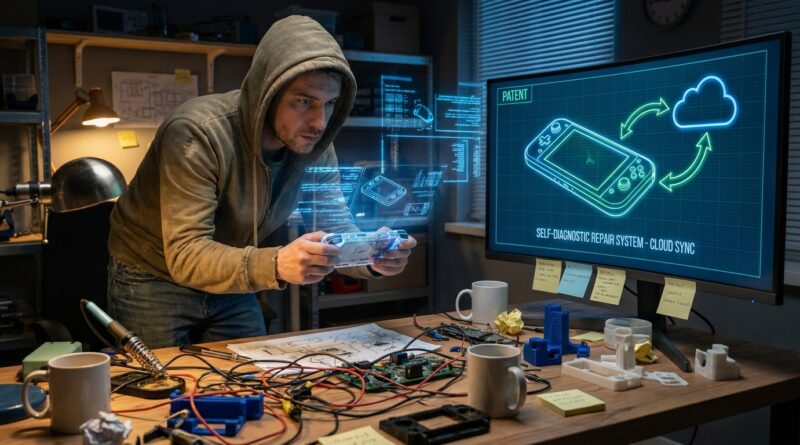
Sony’s Self‑Healing PlayStation And The New ‘Autonomous Device’ Patent Wave: What Solo Inventors Should Learn Right Now
It is hard not to feel a little sick when you see a company like Sony filing patents for products that can spot their own problems, write their own fixes and sort themselves out before the owner even notices. If you are a solo inventor, it can feel like the future just got claimed by someone with a legal team the size of your town. That frustration is real. But this is not the moment to freeze. It is the moment to get specific.
Sony’s self healing PlayStation patent is getting attention because it describes more than a better games console. It points to a wider shift toward autonomous device diagnostics. In plain English, connected products are being taught to watch themselves, report faults, ask a remote system for help and install a fix with little or no user effort. The good news for small inventors is that big patent filings often open just as many doors as they close. If you understand what is actually being claimed, you can still file around the edges, in the gaps and in the practical add-ons that bigger firms often ignore.
⚡ In a Hurry? Key Takeaways
- Sony’s filing matters because it signals a broader move toward devices that diagnose and repair themselves through remote software support.
- If you are a solo inventor, focus now on narrower, practical patent angles like retrofit kits, cloud diagnostic layers and hardware monitoring add-ons.
- Do not copy the headline idea too broadly. The safer move is to claim a specific use case, data flow or repair method that solves a real problem in a defined product category.
What Sony’s filing really means
Strip away the buzz, and the core idea is pretty simple.
A device has a problem. It gathers diagnostic information. That information is sent to a remote system. The remote system figures out what is wrong and generates a fix, which can include software code. Then the device gets patched, tested or restored.
That is why people are talking about the Sony self healing PlayStation patent autonomous device diagnostics angle. It is not just a repair ticket system. It is an attempt to cover a loop of detection, communication, analysis and automated correction.
And that loop can show up almost anywhere.
- Smart thermostats that catch sensor drift
- Security cameras that spot firmware corruption
- Medical wearables that detect bad readings caused by component aging
- Industrial tools that report calibration faults before failure
Gaming got the headline. The pattern is the bigger story.
Why solo inventors should care right now
Patent timing matters more than many first-time filers realize.
When a major company files early in a new category, it starts shaping the vocabulary that patent examiners will see over and over. Terms like autonomous diagnostics, remote remediation, self monitoring logic and automatic patch generation can quickly become the normal language of the field.
Once that happens, broad claims get harder for everyone else.
That does not mean the opportunity is gone. It means you need to stop thinking in giant, vague concepts and start thinking in narrower invention patterns.
What gets harder after a big filing
Claims like “a device that diagnoses itself and repairs itself” are the kind of thing that will run into trouble fast if big players have already staked out the general territory.
What can still be very strong
Claims tied to a specific mechanism, device class, user constraint or repair path can still stand out. For example:
- A retrofit module that adds self-diagnostics to old appliances with no native cloud support
- A cloud system that compares fault signatures across brands while preserving user privacy
- A wearable patching system that delays updates until body-sensor readings are stable
That is where solo inventors can still move quickly.
What Sony is likely trying to protect
We should be careful here. A patent filing is not the same as a final granted patent, and exact claim scope can change. But based on the public discussion around this filing, the likely areas of interest include:
- Remote collection of fault or performance data from a device
- Automated diagnosis using software models
- Generation of corrective code or instructions
- Delivery of that fix back to the device
- Reduced need for direct user troubleshooting
Notice what is missing from that list. It does not automatically lock up every possible self-repair idea in every market.
That is the opening.
Three invention templates solo inventors can use now
1. Hardware add-on template
This is the “plug it into something that already exists” route.
Think of a small board, adapter or inline module that watches power behavior, error signals, vibration, heat, radio performance or sensor drift. It does not need to repair the product itself. It might only detect a fault pattern and trigger the right maintenance action.
Plain-English patent angle: a hardware accessory that gives legacy devices self-monitoring features they did not originally have.
Good targets:
- Older home appliances
- Power tools
- Mobility devices
- Farm equipment
Why this works: Big Tech often files around integrated systems. Retrofit hardware for older, messy, mixed-brand environments is less glamorous and often less crowded.
2. Cloud diagnostics layer template
This is the “brain in the background” route.
Here, your invention is not the device itself. It is the service layer that receives fault data, scores severity, checks historical patterns and decides what kind of fix or guidance should happen next.
Plain-English patent angle: a remote diagnostics service built for a specific class of devices or a special kind of failure.
Good targets:
- Multi-brand smart home devices
- Remote elder care sensors
- Small business point-of-sale gear
- Environmental monitors
Why this works: You can claim the decision logic, fault classification flow, update timing rules or safety thresholds, not just the general idea of remote repair.
3. Retrofit kit template
This is the most practical route for many solo inventors because it starts with a problem people already have.
A retrofit kit can combine a sensor pack, a small controller, a mobile app and a remote support path. Instead of building a whole new product, you are turning ordinary equipment into something that can self-report and accept guided or automated fixes.
Plain-English patent angle: a conversion system that upgrades non-autonomous products into self-diagnosing products.
Good targets:
- HVAC systems
- Water pumps
- Refrigeration units
- Accessibility equipment
Why this works: It is grounded in real market pain. It is easier to explain, easier to prototype and often easier to claim in a concrete way.
How to avoid wasting money on a weak filing
This is where many inventors get into trouble. They get excited by the trend and file something broad, fuzzy and expensive.
Better approach. Answer these five questions before you spend a cent.
1. What exact device category am I talking about?
Not “smart devices.” Say “battery powered home leak detectors” or “wrist-worn glucose monitors.” Specific beats broad.
2. What data is being watched?
Temperature? Voltage noise? Packet loss? Motion drift? Error logs? Specific data creates specific claim language.
3. What triggers the repair action?
A threshold crossing, a pattern match, a failed self-test, or a comparison against fleet-wide behavior?
4. What is the repair, exactly?
New firmware. Parameter reset. Module isolation. Sensor recalibration. Code patch. User prompt. Service dispatch. You need a defined response.
5. Why is this different from ordinary remote support?
This is the key question. If your idea sounds like remote tech support with fancier wording, it is too thin. The invention should include a technical step that changes how diagnosis or repair happens.
Where the real patent openings are likely to appear next
If this patent wave grows the way it looks like it will, some of the best openings will not be in entertainment at all.
Privacy-aware diagnostics
Devices that can report fault states without exposing private user content. Very relevant for home cameras, health wearables and children’s products.
Low-connectivity repair systems
What happens when the device is in a rural area, underground, at sea or in a hospital wing with strict network limits? Systems that can prepare, queue or safely stage autonomous fixes may have room.
Fail-safe patching logic
How does a device decide when not to apply an automatic fix? Safety gating is a huge deal in wearables, mobility products and medical-adjacent tech.
Cross-brand retrofit systems
Many homes and businesses use mixed hardware from five or ten vendors. An independent layer that can monitor and help repair devices across brands could be valuable if claimed carefully.
A simple filing strategy for the next 30 days
You do not need a giant R&D lab to respond to this trend. You need a disciplined notebook and a tight draft.
- Pick one product category, not three.
- Describe one fault type in plain English.
- Map the data path from device to diagnosis to repair.
- Identify the unusual technical step in your system.
- Draft claims around that step, not around the whole future of autonomous products.
If you can sketch the system on one page and explain it to a non-engineer in two minutes, you are on better ground already.
At a Glance: Comparison
| Feature/Aspect | Details | Verdict |
|---|---|---|
| Big Tech broad filing | Often covers the general loop of fault detection, remote analysis and automated repair across a polished ecosystem. | Important signal, but not the end of the road for smaller inventors. |
| Solo inventor best angle | Narrow claims tied to one device class, one repair method, one data source or one retrofit path. | Usually the smarter and cheaper filing strategy. |
| Fastest opportunity area | Hardware add-ons, cloud diagnostics layers and retrofit kits for older products. | Strong near-term targets because they solve real problems and can be claimed concretely. |
Conclusion
Over the past day, one of the most talked-about filings was Sony’s patent for an AI system that remotely diagnoses a PlayStation console and automatically generates code to fix it. That matters far beyond gaming. It is a clear sign that self-monitoring, self-repairing logic is heading into every connected product category, from home devices to medical wearables. For solo inventors, the important lesson is not “Big Tech got there first.” It is “the patent map is being drawn right now.” The first wave of follow-on patents will shape what examiners start seeing as obvious or non-obvious over the next two to three years. If you turn this headline into action now, and build around practical invention templates like hardware add-ons, cloud diagnostics layers and retrofit kits, you can file smarter within weeks, not years. That is how you avoid wasting money on claims that get boxed in, and start placing your ideas where this fast-growing patent pattern still has room.