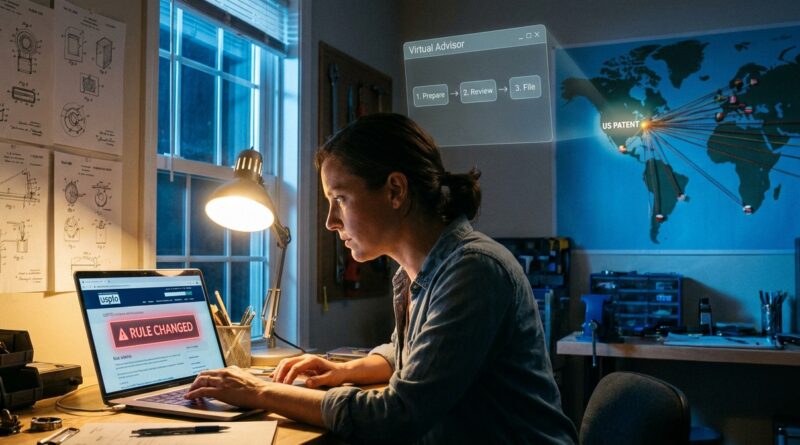
USPTO’s New Foreign-Filer Rule Just Went Live: How Solo Inventors Abroad Can Still Get a US Patent Without Getting Stuck
If you live outside the United States and planned to file your own US patent paperwork, this rule change probably feels like the floor moved under you. That reaction is fair. As of July 20, the USPTO now requires foreign-domiciled applicants to have a US-registered patent attorney or patent agent for USPTO correspondence in most cases. So yes, the old DIY path just got narrower. But it is not game over. You can still do a lot of the prep work yourself, and in some situations you can still file certain papers before a US practitioner steps in. The big win is knowing where the line now sits. If you understand that line, you can avoid a rejected filing strategy, save time, and hand a cleaner package to a practitioner when you need one. Think of this less as a locked door, and more as a new checkpoint you now have to plan for early.
⚡ In a Hurry? Key Takeaways
- Foreign-domiciled applicants can no longer handle most USPTO correspondence on their own. A US-registered practitioner is now required.
- You can still prepare your invention disclosure, draft claims notes, gather drawings, and in some cases start the filing process before counsel takes over.
- The safest move is to stop assuming a full DIY US patent path is still open, because losing time to a fixable paperwork issue can cost months.
What actually changed
The short version is simple. If your domicile is outside the United States, the USPTO now requires you to be represented by a US-registered patent attorney or patent agent for patent matters before the office. This rule is now live, not theoretical.
For solo inventors abroad, that changes the usual plan. Maybe you were writing your own provisional. Maybe you were halfway through a nonprovisional. Maybe you already filed something and expected to answer future USPTO letters yourself. That is the part that now breaks.
The key point is not just filing. It is correspondence and representation before the USPTO. Once your case enters the system and official back-and-forth begins, a foreign-domiciled applicant generally cannot keep going alone.
What “foreign-domiciled” means in plain English
This does not mean your citizenship. It means where your permanent legal residence or principal place of business is located.
If you are a French citizen living in Texas, this rule may not hit you the same way. If you are a US citizen living and working in India, it probably does. The USPTO looks at domicile, not just passport.
If you are not sure how the office would view your situation, do not guess. That is one of the first questions to clear up with a US practitioner.
Why the USPTO did this
The office has been trying to cut down on bad filings, fake representation, and confusion caused by applicants who are outside US legal reach. From the USPTO’s point of view, requiring a US-registered practitioner creates one accountable point of contact who knows the rules.
That may make sense from the agency side. It still creates a very real problem for independent inventors trying to keep costs low. If you are feeling squeezed, you are not imagining it.
For a broader look at the policy shift, this related piece is worth reading: New USPTO Rule Just Raised The Bar For Foreign Filers: What Solo Inventors Need To Change Before They File in the U.S..
What you can still do on your own
1. Prepare the substance of your invention
You can still do the hard thinking yourself. In fact, you should. Write out what the invention does, what problem it solves, what makes it different, and what alternatives or variations exist. Gather photos, sketches, flowcharts, and technical notes.
This work saves legal time later. It also saves money.
2. Draft a rough application package
You can still create a rough draft of the specification, figure list, abstract, and possible claims. It may not be legally polished, but it gives a US practitioner something to work from instead of starting from zero.
Think of it like bringing organized tax records to an accountant. You are not replacing the professional. You are making their job faster and cleaner.
3. Research prior art
You can search patents, published applications, product pages, research papers, and videos that look similar to your idea. Keep notes. Save links. Mark what is close and what is different.
A practitioner can then use that research to shape claims more efficiently.
4. Decide your filing strategy goals
You can still decide whether speed matters most, whether you need a provisional first, whether you plan to seek investors, and whether foreign filings may come later. Those business choices are still yours.
Where you now need a US practitioner
Official representation before the USPTO
This is the big one. If the USPTO requires representation for your situation, the office will expect a US-registered patent attorney or agent to handle correspondence. That includes responses to office actions and many follow-up filings tied to prosecution.
Fixing errors after filing
Minor filing mistakes can snowball fast in patent practice. If you are foreign-domiciled, trying to clean them up without proper representation can leave you stuck waiting for a rule-based answer you cannot personally provide.
Anything where timing matters
Patent deadlines are not friendly. Miss one and the cost to recover can jump quickly, if recovery is even possible. If your case is active, do not wait until the deadline week to look for counsel.
If you already started filing on your own, do this now
First, do not panic-delete anything or start over blindly.
Step 1: Check your current status
Ask three questions.
- Have you filed nothing yet?
- Have you filed a provisional only?
- Have you filed a nonprovisional or received USPTO correspondence?
Your next move depends on which bucket you are in.
Step 2: Gather your file before talking to counsel
Put everything in one folder. Drafts, drawings, priority dates, inventor details, assignment details if any, and every USPTO receipt or notice. The more organized you are, the less time gets burned on admin.
Step 3: Tell the practitioner exactly what deadline is next
Do not send a vague message like, “I need help with my patent.” Send the application number if you have one, the filing date, and the next due date. If there is an office action, attach it.
Step 4: Ask a very direct scope question
Ask whether you need full prosecution representation, help with only the immediate filing, or a review-and-correct engagement. Some practitioners offer narrower help than a full cradle-to-grave package.
Can you still file a provisional application by yourself?
This is where many inventors get tripped up. A provisional application is often seen as the cheap DIY first step. In practice, whether you can still submit one on your own versus whether you can successfully manage what follows are two different questions.
Even if a solo filing seems technically possible at the front end, you should assume that a US practitioner will need to be involved quickly if the rule applies to you. So the practical advice is this: do not build your plan around staying solo all the way through.
Also, a weak provisional can do more harm than good if it fails to properly describe what you later want to claim. Saving legal fees at day one can become an expensive mistake at month twelve.
How to keep costs under control anyway
Use the lawyer for legal work, not typing work
Come prepared with a strong invention summary, clean drawings, inventor info, and a list of possible claim points. That keeps billable time focused on strategy and compliance.
Ask about phased help
Some solo inventors do well with a staged approach:
- Paid consult first
- Review of your draft second
- Final filing package third
- Prosecution support later only if needed
Not every firm will do this, but many smaller practices are more flexible than people think.
Get clear on flat fee versus hourly
Patent costs can feel slippery. Ask what is included. Filing fees? Drawings? IDS work? Office action responses? Foreign associate coordination later? Clarity now prevents ugly surprises later.
Common mistakes foreign solo inventors should avoid
- Assuming citizenship decides the rule. Domicile is what matters.
- Waiting for a USPTO notice before looking for counsel.
- Treating a provisional as “good enough” without proper detail.
- Sending messy notes and expecting cheap cleanup.
- Missing a response deadline while shopping around for the lowest fee.
What a smart path looks like now
A realistic 2026 path for a solo inventor abroad looks like this:
- Do your invention homework yourself.
- Draft a rough package and prior art summary.
- Confirm whether you are foreign-domiciled under USPTO rules.
- Bring in a US-registered practitioner before official correspondence becomes the bottleneck.
- Use the professional for claim quality, rule compliance, and deadlines.
That is not as cheap as the old full-DIY dream. But it is still workable, and usually far cheaper than fixing a broken filing path months later.
At a Glance: Comparison
| Feature/Aspect | Details | Verdict |
|---|---|---|
| DIY preparation | You can still write invention notes, gather drawings, research prior art, and build a rough draft. | Still useful and worth doing |
| USPTO correspondence | Foreign-domiciled applicants now generally need a US-registered practitioner to handle official communication. | Do not plan to handle this alone |
| Cost control | Costs can stay manageable if you organize your materials and use counsel strategically. | Possible, but only with planning |
Conclusion
The important thing to know is that the rule is already in force, and foreign solo inventors are the people most likely to get blindsided by it. If that is you, the goal is not to fight the new system with wishful thinking. It is to adjust fast. You can still do plenty of the groundwork yourself. You just need to know where self-help ends and where a US practitioner must step in. That clarity can save an in-progress application, help you plan the next one correctly, and keep you from wasting months on a DIY route the USPTO will no longer accept. Annoying? Yes. Fatal to your patent plans? No. But from here on out, smart planning beats stubborn filing every time.