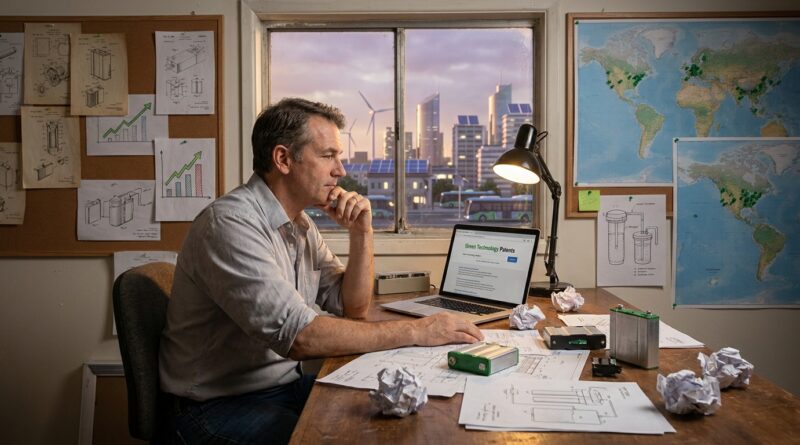
Green Tech Patents Are Quietly Surging: How Solo Inventors Can Own the Next Climate Breakthrough
You are not imagining it. Climate tech really is turning into a serious patent race, and for a solo inventor it can feel like showing up late to a stadium already full of utilities, battery giants, and government-backed labs. That is frustrating, especially when your idea is sitting right there in a sketchbook, prototype, or half-finished CAD model. The good news is that the real action in green technology patent filing trends 2026 is not only happening in giant moonshot projects. A lot of the best openings are in the gaps. Small fixes for grid bottlenecks. Better battery cooling. Water reuse hardware. Lower-carbon building materials that solve one annoying real-world problem. Those edge areas are often where independent inventors can still move fast. If you know where filings are clustering, and where they are still thin, you can shape claims around a problem the market already cares about instead of guessing in the dark.
⚡ In a Hurry? Key Takeaways
- Green patent activity is rising fastest in practical areas like battery storage, grid flexibility, water stress adaptation, and low-carbon materials.
- Start with patent searches by problem, not by buzzword. Look for crowded zones, then find the missing piece your design actually improves.
- You do not need a giant lab to compete, but you do need a clean novelty check, tight claims, and awareness of where public funding and policy are pushing demand.
Why this surge matters to solo inventors
Most people hear “climate patents” and picture massive offshore wind farms or billion-dollar battery factories. That is only part of the story.
A big chunk of new filing activity is happening one layer down. Think connectors, control systems, thermal management parts, monitoring devices, filter materials, recycling methods, and retrofit tools. Those are not always glamorous, but they are often patentable and easier for a small inventor to prototype.
That is what makes green technology patent filing trends 2026 worth watching closely. The growth is real, especially across Europe and Asia where policy pressure, carbon targets, and industrial strategy are driving companies to file fast. If you can spot the pressure points early, you can build around them.
If you want a broader picture of how fast this space is moving, this earlier Patentop piece is a good companion read: Green Tech Patents Just Hit a Record High: How Solo Inventors Can Turn Climate Anxiety Into IP Assets.
Where the real IP land grab is happening
Battery storage and battery life extension
Battery patents are not just about inventing a totally new chemistry. Many filings now focus on making existing systems safer, longer-lasting, easier to cool, easier to recycle, or cheaper to maintain.
That creates room for solo inventors. A better enclosure layout, a thermal interface, a sensor arrangement, a charging control method, or a repair-friendly module design can all matter.
Ask simple questions. Does your idea reduce heat buildup? Does it help second-life battery use? Does it make pack disassembly easier? Those are the kinds of practical claim angles that investors and manufacturers understand right away.
Grid flexibility and demand management
Power grids are under stress. More renewables means more variability. More EV charging means new spikes in demand. That has sparked filing activity around load balancing, microgrids, local storage control, smart switching, and fault detection.
You do not need to own a utility to invent here. You might have a better control cabinet layout, a safer transfer mechanism, a cleaner installation method for retrofits, or a hardware-software combination that helps buildings respond to peak pricing.
The sweet spot is often “boring but useful.” If your idea helps old infrastructure work with newer clean energy systems, that can be a strong place to file.
Water stress adaptation
This area gets less mainstream attention than solar or EVs, which is exactly why it is interesting. Patents are picking up around water reuse, leak detection, low-energy filtration, desalination efficiency, irrigation control, flood resilience hardware, and contamination sensing.
For solo inventors, water is one of the most practical green niches because the problem is local and visible. Farmers, building managers, factories, and municipalities all have pain points here. If you can solve one in a way that is measurable, you may have a patentable improvement and a clear customer story.
Low-carbon materials
Concrete substitutes, cleaner cement mixes, insulation materials, bio-based composites, recycled feedstocks, and coatings that improve energy performance are all seeing more attention.
This field can sound chemistry-heavy, but not every invention needs to be a lab breakthrough. Sometimes the novelty sits in processing steps, mixing methods, curing conditions, layered structures, or installation systems.
If your idea lowers waste, lowers process temperature, extends material life, or helps a contractor install something faster with less energy use, it is worth a closer look.
How to search like a smart inventor, not a panicked one
This is where many people get stuck. They search broad terms like “green energy” or “climate tech” and drown in results. Do it differently.
Start with the problem statement
Use search phrases tied to the pain point. Examples:
- battery thermal runaway prevention module
- microgrid load balancing switch enclosure
- greywater filter cartridge low maintenance
- low carbon cement curing method
That gets you closer to actual prior art instead of press-release language.
Search by use case, then by part
Do two rounds. First search the system. Then search the specific piece you think is new. A lot of solo inventors miss relevant prior art because they only search the whole product and not the valve, bracket, gasket, coating, sensor mount, vent channel, or data flow step that really carries the invention.
Check who is filing
Look at assignees and geography. Are the same five companies filing over and over? That may mean the area is crowded. Are there many university filings but few commercial ones? That may mean the science is emerging but the application side is still open. Are filings clustered in China, Korea, Germany, or Japan? That often hints at where manufacturing or policy support is strongest.
Read claims, not just abstracts
Abstracts make everything sound new. Claims tell you what is actually protected. If a patent claims a broad battery cooling system, there may still be space in a maintenance method, a modular channel geometry, or a sensor placement scheme that solves a different problem.
What good claim angles look like in green tech
Many inventors focus too much on the big dream and not enough on the protectable detail. Patents are often won in the specifics.
Claim the measurable improvement
Better is vague. Better by how much, and in what way, matters. Try to define the result:
- reduced heat concentration in a battery pack
- lower water loss during filtration cleaning
- faster installation time for retrofit insulation panels
- improved peak-load response in a building energy system
Claim the structure and the method
If you only claim the physical device, you may miss value. If you only claim the method, you may leave design-arounds open. In many green tech cases, the strongest filing strategy includes both.
Claim the retrofit angle
New infrastructure gets headlines. Retrofits get budgets. A lot of climate progress will come from upgrading what already exists. If your idea helps an old building, legacy grid component, water system, or industrial process become cleaner without a full replacement, that is commercially attractive.
How to tell if a niche is crowded or still open
Here is a simple test.
Crowded signs
- Dozens of near-identical filings using the same language
- Heavy activity from major corporates in one narrow claim area
- Lots of continuations or family filings around one core platform
Open-edge signs
- Broad system patents but few filings on maintenance, repair, or retrofit details
- Strong policy demand but weak patent depth in practical field components
- Academic research activity without many market-ready patent claims
This matters because the best opportunity for a solo inventor is often not the center of the market. It is the unglamorous corner everyone else assumes is too small, right before it turns out to be essential.
Do not ignore funding and policy signals
Patent trends do not move in a vacuum. Watch where standards, tax credits, grants, and procurement programs are pushing adoption.
If governments are backing grid modernization, heat pumps, industrial efficiency, water resilience, or cleaner building materials, that usually means more buyers, more pilots, and more reason for companies to acquire or license useful IP.
In plain English, follow the money. It does not guarantee a winner, but it tells you where people will soon be shopping for solutions.
A practical 5-step playbook for filing in 2026
1. Pick one climate problem with a budget behind it
Do not start with “I want to help the planet.” Start with “building owners need a cheaper way to cut cooling loads” or “battery recyclers need a safer discharge fixture.”
2. Map the patent landscape fast
Spend a few focused sessions searching recent filings, especially in Europe and Asia. Note repeated claim language, top filers, and gaps.
3. Define your novelty in one sentence
If you cannot explain what is new without ten caveats, the claim may be too fuzzy.
4. Draft around implementation details
Materials, geometry, process sequence, sensor placement, installation method, control logic. That is where real protection often lives.
5. File before you overshare
Be careful with pitch decks, crowdfunding pages, conference demos, and supplier discussions. Green tech communities are collaborative, which is great, but public disclosure can hurt your filing options depending on where and how you disclose.
At a Glance: Comparison
| Feature/Aspect | Details | Verdict |
|---|---|---|
| Battery and storage filings | Very active, but still open in thermal management, safety, repair, second-life use, and modular design details. | Promising if you target a specific pain point, not a giant chemistry claim. |
| Grid flexibility and retrofits | Growing fast because old infrastructure must work with new energy systems and variable loads. | Strong opening for solo inventors with practical hardware or control improvements. |
| Water and low-carbon materials | Less hyped than AI or EV headlines, but packed with local, real-world use cases and policy support. | Often the best edge territory for new entrants. |
Conclusion
If you have felt locked out of climate innovation because you are not a utility, a giant manufacturer, or a well-funded startup, this is the part worth remembering. The green patent surge is real, but it is not happening only at the top. It is spreading through the nuts-and-bolts layers of energy, water, materials, and infrastructure. That helps the Patentop community right now because climate and clean energy filings are in a genuine growth phase globally, especially across Asia and Europe, while a lot of mainstream patent coverage still fixates on generic AI and software stories. When you focus on fast-moving niches like battery storage, grid flexibility, water stress adaptation, and low-carbon materials, then turn those trends into simple search steps and clear claim angles, the field stops feeling closed. It starts looking like what it really is. A policy-backed, funding-backed boom with open edges, where a smart solo inventor can still own something that matters.