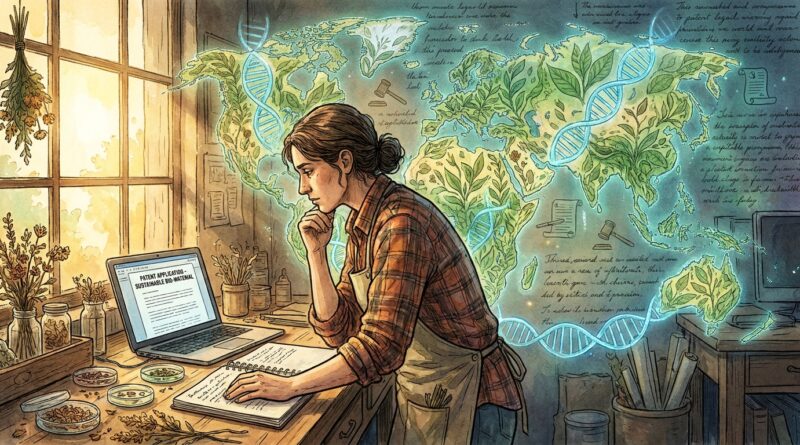
Genetic Resources Are About To Change Patent Rules: How Solo Inventors Can Avoid ‘Biopiracy’ Rejections Before They Start
You can do months of careful patent work, pay real money to file, and still get tripped up by one missing sentence about where a plant, microbe, extract, or traditional remedy idea came from. That is the frustrating part. The invention may be solid. The science may be real. But the paperwork rules are changing, and solo inventors are usually the last to hear about it. The big shift is this. Patent offices are starting to prepare for new disclosure duties tied to genetic resources and traditional knowledge. If your product depends on a seed, fungus, marine sample, herbal extract, fermentation strain, or community knowledge about how something is used, you may soon need to say more, earlier, and with better records. This is not just a problem for pharma giants. It hits one-person labs, startup founders, formulators, food inventors, and garage biologists first, because they often move fast and skip formal source tracking until it is too late.
⚡ In a Hurry? Key Takeaways
- If your invention uses biological material or traditional knowledge, start documenting origin and permissions now. New patent disclosure rules for genetic resources and traditional knowledge are getting real.
- Before filing, make a source file that lists what material you used, where it came from, who supplied it, and whether any community knowledge helped shape the invention.
- This is not just bureaucracy. A missed disclosure can trigger objections, delays, expensive amendments, or claims that your patent relies on biopiracy.
Why this matters now
For years, this issue lived mostly in policy meetings, treaty debates, and specialist IP circles. Now it is moving into procedure. The WIPO Treaty on Intellectual Property, Genetic Resources and Associated Traditional Knowledge signals that patent applicants may face more direct questions when inventions are based on genetic resources or associated traditional knowledge.
That sounds abstract until you picture a real filing. You created a skin care formula based on a rainforest extract. You engineered a fermentation process using a wild yeast strain. You built an agri-tech treatment around a plant trait found in a local landrace. Under emerging rules, a patent office may want to know the source of that biological material, or whether traditional knowledge helped you get there.
And if you cannot answer cleanly, the problem is not just embarrassment. It can become a formal defect, a delay, or a challenge to the credibility of the whole application.
What the new rules are trying to fix
At the heart of this is a long-running complaint. Companies and researchers have sometimes patented inventions based on natural materials or community knowledge without clearly saying where those inputs came from. Critics call that biopiracy.
The new direction does not ban patents on inventions involving natural materials. It pushes for transparency. Patent offices want applicants to disclose relevant information about the origin or source of genetic resources and associated traditional knowledge when those inputs were important to the invention.
That means the question is shifting from “Is my invention patentable?” to “Can I prove I handled the source story properly?”
Who should worry most
If you are a solo inventor, small startup, or independent R&D founder in any of these areas, pay attention:
- Biotech
- Agri-tech
- Food science
- Cosmetics and personal care
- Nutraceuticals
- Biomaterials
- Synthetic biology that starts from wild or legacy strains
Large companies usually have counsel, sourcing teams, and compliance people. You probably do not. That is why small inventors are more exposed. They often keep excellent lab notes about performance and almost no notes about origin, access rights, or traditional-knowledge inputs.
What counts as a genetic resource or traditional knowledge issue
Genetic resources
Think broadly. This can include plants, seeds, microbes, fungi, algae, animal-derived material, cell lines, and natural extracts where biological origin matters to the invention.
Associated traditional knowledge
This usually means knowledge held by Indigenous peoples or local communities about the use, properties, preparation, or value of biological resources. If your idea started because a community has long used a certain bark, root, resin, leaf, or fermentation method for a known purpose, that may be relevant.
Grey-zone cases
Many solo inventors land here. Maybe you bought a botanical ingredient from a distributor, found an old ethnobotany paper, and then created a new extraction method. You may feel far removed from the original source. Patent offices may still care whether the invention is based on a genetic resource or associated traditional knowledge.
The practical risk nobody likes to talk about
A lot of inventors assume disclosure issues can be cleaned up later. Sometimes they can. Sometimes they cannot.
Patent applications are unforgiving about timing. If a patent office asks for origin details and your records are vague, you may scramble to reconstruct years-old sourcing. Suppliers may have changed. Emails may be gone. Samples may have been relabeled. The person who introduced you to the source material may no longer be reachable.
That is how a small omission turns into expensive emergency lawyering.
A simple framework to avoid trouble before filing
1. Ask the “nature test” early
Before drafting claims, ask one blunt question. Does my invention depend in any meaningful way on biological material from nature or on knowledge from a local or Indigenous community?
If the answer is yes, or even maybe, flag it.
2. Build a source file
Create one folder for each invention. Put these items in it:
- Name of the material used
- Scientific name if known
- Supplier name and contact details
- Country of origin, if known
- Collection location, if known
- Date acquired
- Any material transfer agreement, invoice, permit, or license
- Any papers, books, field notes, or interviews that pointed you to the material
- Any evidence that traditional knowledge informed the invention
This does not need to be fancy. A clean spreadsheet and a scanned document folder already puts you ahead of many applicants.
3. Separate inspiration from invention
Patent law still cares about what is new and inventive. So be precise. If traditional knowledge told you a plant had anti-inflammatory use, but your invention is a novel purification method or a new delivery system, say so clearly in your records and drafting notes.
You are not trying to hide the source. You are trying to explain the leap from known use to your specific invention.
4. Check access and benefit-sharing issues
This is where many inventors get caught off guard. Some countries have rules on access to genetic resources and benefit-sharing, often linked to the Nagoya Protocol or local laws. Patent disclosure and access compliance are not the same thing, but they can collide fast.
If material came from another country, or from a region with Indigenous or community rights issues, ask whether collection, export, research use, or commercialization required permission.
5. Draft your patent with disclosure in mind
Do not bolt this on at the end. Tell your patent attorney or patent drafter up front that the invention may raise source or traditional-knowledge questions. Ask them specifically how they are handling patent disclosure rules for genetic resources and traditional knowledge in the application strategy.
If they look surprised, that is a useful warning sign.
Common mistakes solo inventors make
“I bought it from a supplier, so I am covered”
Not necessarily. A reseller invoice may show who sold it to you, not where the material originally came from or whether access rules were followed.
“It is publicly known, so origin does not matter”
Publicly known use does not always erase source questions, especially if the invention is based on a genetic resource and offices require formal disclosure.
“I only used a small amount in early testing”
If that material materially informed the invention, it may still matter.
“I can fix it after filing”
Sometimes yes. Sometimes no. Late fixes are often messy, costly, and narrower than what good early drafting could have achieved.
How to talk to your patent attorney without sounding like a lawyer
You do not need perfect legal language. Use plain English. Ask:
- Does my invention trigger any disclosure issue related to genetic resources?
- Did any traditional knowledge influence what we are claiming?
- What source records should I gather before filing?
- Do we know the country of origin of the biological material?
- Could any access or permission issue affect filing or enforcement later?
- How should we word the specification so we are accurate without hurting patent scope?
Those six questions can save you weeks later.
What good record-keeping looks like in real life
Let us say you are developing a cosmetic serum based on a mushroom extract.
Bad record-keeping looks like this. “Sample from online supplier. Good antioxidant profile.”
Better record-keeping looks like this. “Trametes versicolor extract purchased from Supplier X on March 12, 2026. Supplier states cultivated material from Country Y. COA attached. Initial literature review included paper on traditional topical use in Region Z. Claimed invention is a stabilized encapsulation system combined with peptide carrier, not the raw extract itself.”
See the difference? One note says almost nothing. The other gives your future patent team something usable.
What offices may care about going forward
Implementation will not be identical everywhere. That is important. Different national and regional offices may adopt different forms, timing rules, and consequences for incomplete disclosure.
But the trend is clear. More transparency. More formal questions. Less tolerance for vague source stories.
So do not wait for every office in the world to finalize every form. By then, your application may already be filed on old habits.
If you are using old samples, legacy strains, or inherited lab material
This is a quiet danger zone. Many founders start with material inherited from a former employer, university lab, collaborator, or old freezer stock. The science may work fine. The paper trail may be awful.
If you cannot clearly trace what the material is, where it came from, and what rights attach to it, stop and sort that out before you build a patent family around it. An invention is only as clean as its underlying facts.
How to reduce the chance of a “biopiracy” accusation
You do not avoid that risk by saying less. You reduce it by being organized, accurate, and fair.
- Document source and chain of custody
- Note any traditional-knowledge inputs honestly
- Check permissions and restrictions early
- Make clear what part of your work is actually inventive
- Do not overclaim raw natural materials as if you invented nature itself
That last point matters a lot. Broad claims to natural substances with thin inventive framing are exactly the kind of filings that attract scrutiny.
At a Glance: Comparison
| Feature/Aspect | Details | Verdict |
|---|---|---|
| Source documentation | Keep supplier records, origin data, permits, agreements, and notes on how the material entered your R&D process. | Do this before drafting. It is the easiest win. |
| Traditional knowledge review | Check whether community knowledge pointed you toward the biological resource, use case, or preparation method. | Worth a careful review. Hidden risk for small inventors. |
| Late-stage cleanup | Trying to reconstruct source facts after filing often leads to delays, narrow fixes, or inconsistent statements. | Avoid if possible. Early prep is cheaper and safer. |
Conclusion
The main thing to remember is simple. This is no longer just treaty talk. The WIPO Treaty on Intellectual Property, Genetic Resources and Associated Traditional Knowledge is moving from abstract diplomacy into real procedure, with member states and PCT authorities preparing concrete disclosure requirements for inventions based on biological material or traditional knowledge. Solo inventors in biotech, agri-tech, food, cosmetics and bio-materials are the most exposed, because they rely heavily on natural inputs but rarely get early compliance guidance. The good news is that you do not need a giant legal department to protect yourself. You need a paper trail, a few smart questions, and the discipline to treat source information as part of the invention file, not an afterthought. Do that now, and you are far less likely to face fatal formal defects, accusations of biopiracy, or a panicked rewrite just as global offices start turning these rules into everyday patent practice.