AI Patent Analytics Is Quietly Becoming the New Prior Art Search: How Solo Inventors Can Use It To File Smarter, Not Just Faster
You can feel the patent race speeding up, and that is exactly what makes modern patent search so maddening. Every tool seems built for a law firm team with endless tabs open, not one inventor at a kitchen table trying to figure out a single practical question. Is this idea still worth filing, or am I about to spend money protecting something five bigger players already boxed in? That frustration is real. The good news is that a quiet shift is happening. AI patent analytics for solo inventors is turning giant piles of filings into something much more useful, a map. Not a perfect map, and not a substitute for a patent attorney, but a very helpful one. If you can read where filings are clustering, where they are slowing down, and how claims are being phrased, you can make smarter choices now. Not just faster choices. Smarter ones, with less guesswork and fewer expensive dead ends.
⚡ In a Hurry? Key Takeaways
- AI patent analytics can help solo inventors spot crowded claim areas and find under-patented niches before filing.
- Start with one invention concept, compare assignees, filing trends, and claim language, then decide what to pause, refine, or file.
- These tools improve judgment, but they do not replace a proper legal review or freedom-to-operate analysis.
Why this matters now
For years, prior art search was mostly a scavenger hunt. You typed in keywords, opened dozens of patents, and hoped your patience held out longer than your confusion. That still matters. But the newer layer on top of patent data is what changes the game.
Instead of just asking, “Has anyone patented this?” you can now ask better questions. Who is filing in this space? Which subtopic is heating up? Which one looks oddly quiet? Are competitors chasing hardware claims, software claims, manufacturing methods, or workflow claims? That is where analytics earns its keep.
For solo inventors, this is important because you usually do not need ten reports. You need one good decision. Should I file this idea, narrow it, broaden it, or drop it?
What AI patent analytics actually does
Think of it as search plus pattern spotting.
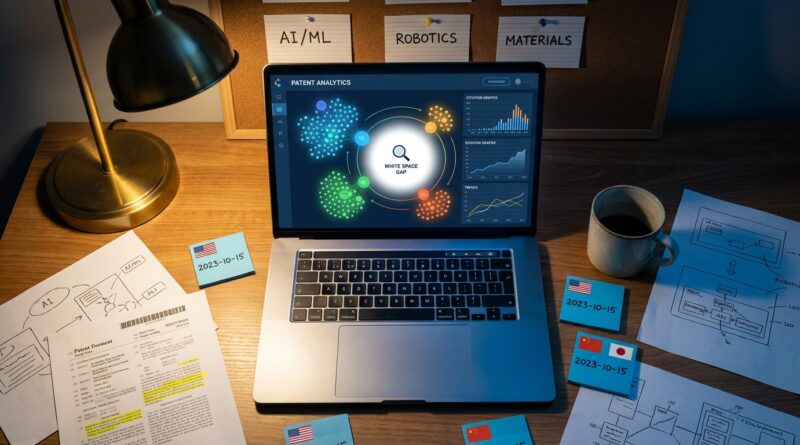
Tools like Questel, PatSnap, and WIPO’s analytics dashboards take patent filings, classifications, assignees, citation links, and claim text, then organize them into trends you can actually see. Some show topic clusters. Some show filing growth over time. Some compare major players. Some try to group similar inventions even when the wording is different.
That matters because patents are full of language games. One company says “adaptive sensor calibration.” Another says “dynamic signal adjustment.” A normal keyword search might treat those as separate worlds. An analytics tool is better at seeing that they may belong to the same race.
The big shift: from document search to landscape reading
Old-school searching asks whether Patent A looks similar to your invention.
Landscape reading asks whether your whole concept is entering a traffic jam.
That is a better question early on. If thirty companies are piling into one narrow lane, your clever feature may still be patentable, but the path gets harder. Examiners will have more art to cite. Competitors will have more overlapping language. You may end up with a narrow claim that is technically granted but not very useful.
On the other hand, if analytics shows an adjacent area with rising interest but fewer dense filings, that may be your opening.
Start cheap, not fancy
You do not need a corporate subscription on day one. In fact, many solo inventors should begin with free or low-cost data sources, then use trial access, limited reports, or consultant help only when the idea survives first review.
If you want a good starting point for free public data, read USPTO’s New Open Data Portal Just Quietly Changed Patent Research: How Solo Inventors Can Piggyback On Big‑Firm Analytics For Free. It is a useful companion to this process because the smartest budget move is often to do your first sorting with public tools, then spend money only when the signal looks promising.
A simple 5-step workflow for solo inventors
1. Write down the invention in plain English first
Before opening any platform, describe your concept in one sentence. Then write three versions of it.
Version one should describe the problem. Version two should describe the mechanism. Version three should describe the outcome.
For example:
Problem: “Reduce false alarms in home water leak detection.”
Mechanism: “Use temperature and vibration data with moisture sensing to filter bad readings.”
Outcome: “Improve leak alerts by combining multiple sensor inputs before sending a notification.”
This helps because patents often hide your idea behind different wording. If you only search the exact phrase you use in your head, you will miss a lot.
2. Search for clusters, not just single patents
Now use your chosen tool and look for these patterns:
- Top assignees in the space
- Filing trend over the last 3 to 5 years
- Common CPC or IPC classes
- Frequently repeated claim terms
- Citation-heavy patents that everyone seems to orbit
This is where AI patent analytics for solo inventors starts to pay off. You are no longer just collecting similar patents. You are seeing the shape of the field.
If one subtopic has exploding filings and many large assignees, that is a warning sign. If another has modest growth, scattered players, and less repetitive claim language, that may be worth a closer look.
3. Mark the red zones, yellow zones, and green zones
Make this visual and simple.
Red zone: crowded, heavily cited, similar claim wording everywhere, major companies active.
Yellow zone: active but not locked down, claims vary, some open room in implementation details.
Green zone: a real problem area with fewer filings, weak claim density, or a new use case that has not been framed well yet.
You are not looking for an empty field. Truly empty fields can mean no market, not just no competition. You want a place where the need is real but the claim herd has not fully arrived.
4. Compare your idea against the language of the herd
This is where many inventors slip. They find a crowded area, then file with the same framing as everyone else, hoping one extra detail saves them.
Instead, ask:
- What assumptions do these claims keep repeating?
- What input, output, hardware setup, or user context do they ignore?
- Are most filings aimed at enterprise use while your version fits consumer use?
- Are competitors claiming the method, but not the calibration process, training flow, or deployment condition?
You may discover that your invention is not a better version of the crowded idea. It is actually a side-door version, and that is often easier to protect.
5. Make one concrete decision this week
This process should end with a decision, not a folder full of screenshots.
Pick one:
- Stop working on it because the lane is too dense and your edge is too thin.
- Double down because the niche is active but still open enough to support a stronger filing.
- Reframe the claim so you are describing a less crowded implementation, workflow, or technical effect.
If your research does not change your next move, you are just browsing patents for sport.
How to use specific tools without drowning in them
Questel
Questel is strong for professional patent searching and analytics, but it can feel like a lot at first. For a solo inventor, the useful part is not every menu. It is the ability to compare families, legal status, classifications, and text patterns. Use it to spot repeated claim structures and to see which companies are filing broadly versus narrowly.
PatSnap
PatSnap is often easier to think about as a landscape tool. Good for trend lines, technology clusters, and competitor movement. If your question is “Which subfield is getting crowded fastest?” this kind of interface can be easier to read than a long list of patent numbers.
WIPO analytics dashboards
WIPO’s own tools can be very handy for a first-pass international picture. If you are trying to understand whether a topic is mostly active in the US, Europe, China, or spread across all of them, these dashboards can give you a quick directional read.
The trick with all three is the same. Do not start broad and keep clicking forever. Start with a narrow invention statement, identify the nearest cluster, then work outward one ring at a time.
Three mistakes solo inventors make with analytics
Mistake 1: Confusing activity with danger
A busy category is not automatically bad. Sometimes it means there is a real market. The issue is not whether others are filing. The issue is whether they are filing in the exact claim lane you need.
Mistake 2: Treating AI grouping as perfect truth
These tools are smart. They are not magic. Topic clustering can miss nuance. Similarity scores can overstate overlap. Always read a sample of the actual claims, not just the dashboard summary.
Mistake 3: Filing based on novelty alone
Novel is not enough. A claim can be technically new and still commercially weak if it sits inside a wall of adjacent patents. You want room to operate and room to matter.
How to phrase a claim just outside the herd
This is where analytics becomes practical.
Let’s say everyone is claiming a system that detects an event using sensor fusion. Fine. The herd is on “detection using combined inputs.” Your opportunity may sit elsewhere:
- The calibration sequence before detection starts
- The threshold adjustment based on context
- The way false positives are filtered after initial detection
- The power-saving mode that changes how sensing happens
- The user feedback loop that retrains the detection logic
Same broad field. Different technical center of gravity.
You are not trying to play word games. You are trying to identify the actual inventive step that others are glossing over.
What to stop working on, what to double down on
Stop working on it if:
- Claim language across top filings looks almost identical to your core concept
- Large assignees dominate the exact implementation you had in mind
- Citations keep pointing back to a mature cluster with little variation
- Your “novelty” is mostly a minor parameter tweak
Double down if:
- The problem is real, but solutions are still fragmented
- Claims vary widely, which often means the field is not settled
- Competitors focus on one deployment context while yours fits another
- You can define a cleaner technical advantage than the existing filings do
Where legal advice still matters
This part is worth saying plainly. AI patent analytics is a decision aid. It is not legal protection by itself.
You still need a proper patentability review before filing anything important. And if you plan to sell a product, you may also need freedom-to-operate analysis, which is a different question. Patentability asks whether you can likely get a patent. Freedom to operate asks whether your product might still step on someone else’s rights.
Those are not the same thing, and analytics dashboards do not erase that difference.
At a Glance: Comparison
| Feature/Aspect | Details | Verdict |
|---|---|---|
| Traditional prior art search | Good for finding specific references, but slow and easy to miss broader filing patterns and claim clusters. | Still necessary, but not enough by itself. |
| AI patent analytics platforms | Useful for trend mapping, competitor tracking, topic grouping, and spotting crowded versus open niches. | Best for deciding where and how to aim before filing. |
| Best use for solo inventors | Use free and trial tools to narrow the field, then spend on legal review only for the ideas that survive the filter. | Smartest balance of cost, speed, and risk. |
Conclusion
The real change here is not that patents suddenly got simple. They did not. It is that the fastest-growing part of the patent world is no longer just the filings themselves, but the AI-powered analytics sitting on top of them. Those tools turn raw applications into live maps of who is moving where. For a solo inventor or small team, learning to read those maps can keep you from tossing a good idea into a packed lane. It helps you aim at under-patented niches that examiners and competitors are only starting to notice. If you use Questel, PatSnap, WIPO dashboards, or even a smart mix of public data and trial access, the goal is the same. Make one concrete filing decision this week. Decide what to stop working on, what to push harder, and how to phrase a claim so it lands just outside the herd instead of getting buried inside it.