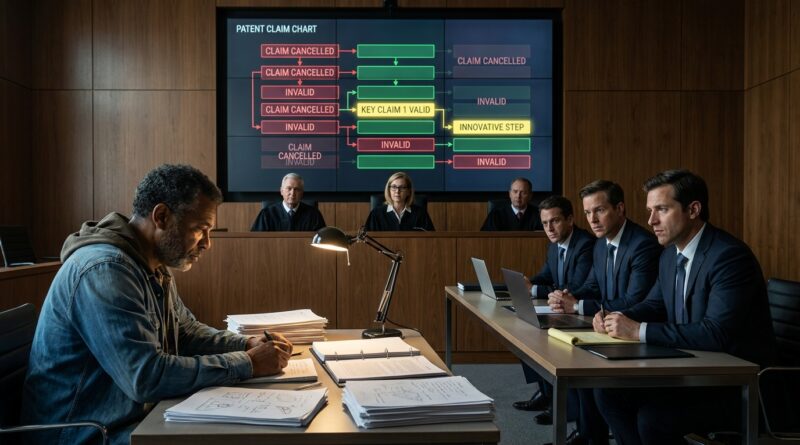
PTAB Is Quietly Shredding Claims: What Solo Inventors Must Change In Their Patent Drafting Now
You spend months, sometimes years, getting a patent application on file. Then a real challenger shows up, files at the PTAB, and suddenly the claims that looked solid start dropping like loose tiles off a roof. That is not just frustrating. For solo inventors, it can be financially devastating. Fresh June and July 2026 numbers show the Patent Trial and Appeal Board cancelling more than half of instituted claims, and in nearly half of recent final written decisions, every instituted or substitute claim was wiped out. Those are ugly odds if your application was drafted thin, broad, and full of unsupported wishful language. The good news is this problem is not random. Patterns are showing up. Certain claim styles attract obviousness attacks. Certain specs leave no safe fallback. And certain dependent claim structures give inventors a much better chance of keeping at least some value alive when the fight starts. That means you can change how you draft now, before it is too late.
⚡ In a Hurry? Key Takeaways
- PTAB claim cancellation trends in 2026 show that broad, weakly supported claims are getting hit hard, so solo inventors need tighter drafting from day one.
- Build your specification with clear technical details, working examples, fallback positions, and narrower dependent claims that can survive if the main claim falls.
- A patent that is harder to challenge is often more valuable than a flashy broad claim set that collapses the first time someone fights back.
Why this matters right now
The PTAB has always been tough. What is different now is how clear the warning signs are. Recent 2026 decisions show a harsh pattern. Once review is instituted, a lot of claims do not make it out alive.
If you are a solo inventor, this changes the whole mindset. The old dream was simple. File broad. Get the patent. Worry about enforcement later. That approach can backfire badly when your first serious opponent points to prior art combinations, argues obviousness, and shows the Board that your spec does not really support the distinctions you are trying to hang onto.
Big companies can sometimes survive that. They may have continuation chains, backup filings, and litigation budgets. Solo inventors usually do not. You often get one clean shot to draft this thing properly.
What the cancellation trend is really telling you
These PTAB claim cancellation trends in 2026 are not just scary statistics. They are feedback. The Board is showing inventors, in plain terms, what tends to break under pressure.
1. Broad functional claims are easy targets
If your claim says a component is “configured to optimize,” “adapt to,” “manage,” or “improve” something, but the specification does not explain exactly how, challengers smell blood. Functional language is not forbidden. But when it stands in for missing technical detail, it becomes an obviousness magnet.
Why? Because a challenger can often stitch together older references that each perform part of the function and then argue that combining them would have been routine. If your application does not clearly describe the specific mechanism, sequence, architecture, thresholds, data structures, or control logic that make your approach different, your claim may look like a goal, not an invention.
2. Thin specifications leave you nowhere to retreat
Many solo inventors put almost all their energy into the claims. That is understandable, but risky. At the PTAB, the specification is your emergency food supply. If the independent claims get challenged, you need fallback support for narrower versions.
If the spec only gives one high-level version of the invention, you may not have enough written description support to amend effectively or defend key limitations.
3. Fragile dependent claims are not real backup
A lot of dependent claims are drafted like decoration. They add small, generic features that do not change the obviousness picture. If independent claim 1 falls, claims 2 through 20 often fall with it because they do not add enough real structure or enough specific technical limits.
A good dependent claim should act like a lifeboat. Too many are just extra deck chairs.
What solo inventors should change in their drafting now
Write the specification like someone will attack every important word
This is the biggest change. Do not write the spec just to satisfy filing day. Write it for future combat.
For each important feature, include:
- What the feature is
- How it works
- Why it solves the problem better than ordinary approaches
- At least one concrete example
- Possible variations, ranges, alternatives, and implementation details
Think in layers. Start broad, then get more specific. If your invention uses a scoring engine, do not stop there. Describe inputs, weighting methods, update timing, threshold logic, exception handling, data storage, user interactions, and alternative scoring models.
This does two things. First, it makes your novelty story more believable. Second, it gives you ammunition for narrower claims later.
Claim mechanisms, not just results
A claim that covers “a system that improves battery life” is asking for trouble. A claim that recites a specific sequence of sensor polling, a defined sleep-wake rule, and a trigger threshold tied to measured conditions is much easier to defend.
Non-techies sometimes think broader is always better. In patent survival terms, broader is often weaker. A narrower claim built around the real technical trick can be far more valuable than a grand statement that reads well and dies young.
Avoid obviousness magnets
Some drafting habits almost invite an obviousness challenge. Watch for these:
- Claims that simply automate a known manual process
- Claims that combine familiar parts without explaining a non-obvious interaction
- Claims that use result-only language like “optimized,” “intelligent,” or “efficient” without a concrete method
- Claims that rely on generic computer components doing generic computer things
- Claims that omit the constraint, timing rule, data relationship, or physical arrangement that actually matters
If you read your claim and it sounds like something a product manager would say in a meeting, it may be too abstract or too high-level for a fight at the PTAB.
Draft dependent claims that can actually survive alone
This is where solo inventors can make a real upgrade.
Your dependent claims should not all make the same kind of narrowing move. Spread the risk. Create different fallback lanes.
For example, one set of dependents might narrow by:
- Specific data sources
- Defined numerical ranges
- Particular component relationships
- Ordered process steps
- Error-checking or validation steps
- A specific training or calibration method
- A hardware arrangement rather than software-only language
This matters because a challenger may have art for one narrowing feature but not another. You are trying to avoid a domino collapse.
Put your best fallback positions in the spec before you need them
You cannot safely invent support later. If a narrower feature could save the claim in a future PTAB challenge, it needs to be described in the original filing.
That means including:
- Alternative thresholds and value ranges
- Optional but useful processing steps
- Specific materials, architectures, or module relationships
- Different operating modes
- Technical reasons why one embodiment works better in certain conditions
When people say “support the claims,” this is what they mean in practice.
How to stress-test your draft before filing
Here is a simple plain-English test you can use.
Ask question one: What is the real point of difference?
If you cannot explain the invention’s true technical difference in two or three plain sentences, your draft probably is not focused enough.
Ask question two: Is that difference actually described?
Not implied. Not hinted at. Described. If your best argument for patentability depends on a detail that appears only in your head, you have a problem.
Ask question three: If claim 1 dies, what claims still matter?
Look at your dependent claims one by one. Would any of them be worth enforcing on their own? Would any of them clearly avoid the art most likely to be cited? If not, rewrite them.
Ask question four: Does the spec support at least three narrower paths?
You want multiple fallback routes. One based on structure. One based on process sequence. One based on measurable parameters or conditions. That is not a magic formula, but it is a useful habit.
What not to copy from big-company patent styles
Solo inventors often copy published patents from giant companies. That makes sense at first glance, but it can mislead you.
Large companies may file broad initial claims because they have resources to keep prosecuting, file continuations, and refine strategy later. They also may tolerate some claim loss because they own a huge portfolio.
You probably do not have that luxury.
Your filing should be leaner and more deliberate. Not tiny. Not cheap-looking. Just focused. Every major claimed idea should be anchored to actual disclosure. Every dependent claim should have a purpose. Every broad term should have examples behind it.
A practical drafting model for solo inventors
Here is a safer way to think about patent drafting in the current PTAB climate:
Layer 1: One or two commercially meaningful broad claims
These should still be broad enough to matter, but not so broad that they read like a marketing slogan.
Layer 2: Several medium-scope dependent claims
These should add technical substance, not cosmetic extras.
Layer 3: A handful of narrow, defendable claims
These are your survival claims. They may not catch every competitor, but they may stay standing.
Layer 4: A specification full of explicit backup support
This is what lets you defend, amend, and adapt if challenged.
That four-layer approach is often smarter for a solo inventor than chasing the broadest possible claim set at filing.
The money question: Is narrower still worth it?
Usually, yes.
A claim that survives is worth more than a claim that impresses people for six months and then gets cancelled. Investors, licensees, and potential acquirers care about durability. They may never say it in those exact words, but they care.
A patent that can survive scrutiny has more practical value than one that exists only on paper.
At a Glance: Comparison
| Feature/Aspect | Details | Verdict |
|---|---|---|
| Broad independent claims | Useful for reach, but risky if written in functional, result-only language with weak spec support. | Use carefully. Broad is fine, unsupported is dangerous. |
| Detailed specification support | Provides written description, fallback positions, examples, variations, and amendment support during a challenge. | Essential. This is your safety net. |
| Strategic dependent claims | Can preserve value by adding distinct technical limits that avoid prior art in different ways. | Highly recommended. Build several real fallback paths. |
Conclusion
The message from recent PTAB decisions is blunt. A patent that looks fine at filing can still crumble once a serious challenger arrives. That is why this topic matters right now. Fresh statistics from June and July 2026 show the PTAB cancelling over half of instituted claims and wiping out all instituted or substitute claims in nearly half of its recent final decisions. That is a brutal environment for under-drafted solo applications. The upside is that these cancellation patterns point to practical fixes. Support critical limitations clearly in the specification. Stay away from obviousness magnets. Build dependent claims that can stand on their own if the main claim falls. Solo inventors do not need to mimic big-company claim styles that are getting gutted at the Board. You are often better off filing leaner, better-supported patents that are built from day one to survive real-world attacks. That does not guarantee victory, but it gives your invention a much better fighting chance.