Gaming Patents Are Quietly Predicting The Future Of Play: How Solo Inventors Can Spot The Next Hit Before It Shows Up On Steam
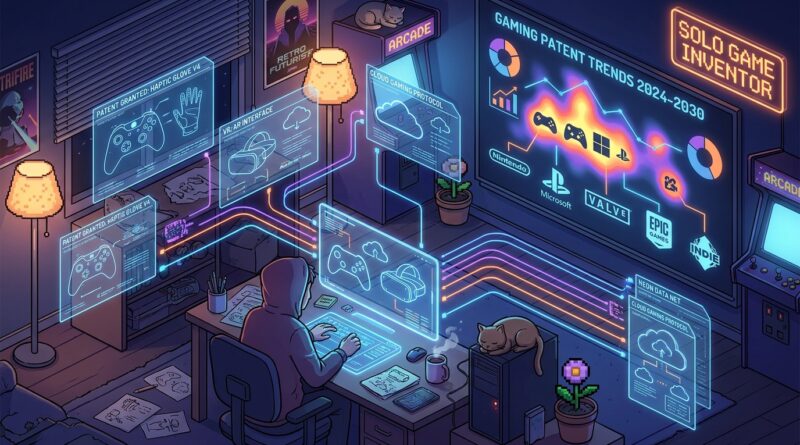
If you are a solo game developer or tinkering inventor, it is easy to feel like the big studios are always three moves ahead. They have research teams, patent lawyers, hardware labs, and enough cash to test ideas you may not even hear about until a flashy trailer drops. That part is frustrating. But here is the good news. The same companies that seem impossible to track often tell you exactly where they are heading. They do it in patent filings. Quietly. Constantly. And if you pay attention to gaming patent trends 2026, you can spot patterns long before they become store pages, launch events, or genre copycats. Recent analysis threads breaking down hundreds of 2026 filings show clear clusters around VR and AR, unusual controllers, cloud-synced game states, and AI-assisted balancing. For indie builders, that is not trivia. It is a roadmap, and it is free to read if you know what to look for.
⚡ In a Hurry? Key Takeaways
- Gaming patent trends 2026 suggest major players are focusing on VR and AR systems, new input methods, cloud-linked gameplay, and AI tools that adjust balance in real time.
- Solo inventors can use patent filings as an early scouting tool to find white space, test demand, and write smarter claims before building too far in the dark.
- A patent filing is not a guaranteed product launch, but repeated filings across the same theme are strong signals worth tracking.
Why patents matter more than game trailers
Trailers are marketing. Patents are planning.
That does not mean every patent becomes a shipped product. Far from it. Big companies file plenty of defensive patents, backup ideas, and moonshots that never leave the lab. But when you see dozens or even hundreds of filings clustering around the same kind of problem, that is a strong sign something important is brewing.
Think of patents as weather reports, not train schedules. They do not tell you the exact day something will arrive. They do tell you which way the wind is blowing.
For anyone building a game tool, control scheme, headset accessory, online system, or gameplay mechanic, that is useful. You are not just reading legal paperwork. You are reading product intent.
What the latest gaming patent trends 2026 are pointing to
VR and AR are getting more practical
A lot of recent filings point to VR and AR becoming less gimmicky and more usable day to day. The themes are familiar, but the details matter. Better spatial tracking. More comfortable interactions. Less friction when moving between physical and digital spaces. More ways to anchor game objects in the real world.
If you are a solo builder, the takeaway is simple. Do not just think “make a VR game.” Think about the annoying parts users still deal with. Fatigue. awkward menus. setup friction. motion mismatch. shared spaces. Accessibility improvements in those areas can be just as valuable as a new game concept.
Novel controllers are back on the table
This is one of the more interesting clusters. Filings are exploring alternative grips, touch patterns, motion inputs, adaptive feedback, and hybrid controller designs that blur the line between standard gamepads, wearables, and gesture systems.
That matters because hardware shifts often create software openings. When input changes, game design changes with it. A solo inventor may not build the next controller, but they can build the training layer, calibration tool, accessory, compatibility bridge, or game mechanic that suddenly makes a new input method useful.
Cloud-synced game states are becoming a bigger deal
This sounds dry until you translate it into normal language. Your game remembering more about what happened, where it happened, and how it should continue across devices, sessions, and players.
That can mean better handoff between mobile and console. Smarter spectator or co-op systems. More persistent shared worlds. Cleaner reconnects after interruptions. Even single-player experiences that feel more alive because the world state follows the player better.
If you build backend tools or game infrastructure, this is a signal worth watching closely.
AI-assisted balancing is moving from theory to workflow
Not “AI makes the whole game.” More like AI helps tune difficulty, item strength, matchmaking, level flow, or player progression based on actual play patterns.
That is a much more practical use case. It is also one solo inventors can act on right now.
You do not need to outspend a major platform to make something useful here. You can build testing dashboards, balancing assistants, simulation tools, or player-behavior analysis layers aimed at small studios who need help but cannot hire a full analytics team.
How solo inventors can turn patent filings into a scouting workflow
Step 1: Track clusters, not one-off weird ideas
One strange filing is interesting. Ten related filings across several companies is a trend.
Make a simple sheet. Log the company, filing date, short summary, and category. After a few weeks, patterns start to jump out. You are looking for repeated problems being solved in slightly different ways.
Step 2: Translate legal language into user pain
This is where many people give up. Patent language can be stiff and bloated. Ignore the formal wording for a minute and ask one plain question.
What annoying thing is this trying to fix?
That question turns “method and apparatus for dynamic haptic state modulation” into “they are trying to make feedback feel more precise and less distracting.” Now you can think like a builder again.
Step 3: Look for white space around the edges
You do not want to copy what a giant company is trying to lock up. You want to notice what they are not covering well.
Maybe a company is focused on the controller itself, but not the onboarding software. Maybe they care about cloud sync for multiplayer, but not accessibility for solo play. Maybe they protect a balancing system for competitive games, but not a lightweight version for small co-op titles.
That edge space is often where solo inventors can move faster.
Step 4: Validate before you build too much
Patent signals help you avoid building in a vacuum. If multiple platforms are filing around a certain interaction model, that suggests market interest. Not certainty, but interest.
Use that to pressure-test your own idea. Is your concept aligned with an emerging shift, or are you solving a problem nobody else seems to care about?
Step 5: Tighten your own patent strategy
If you are planning to file, these trend maps can also help you write better. You can see how others define the problem, where the crowded claim areas are, and where your version is actually different.
And filing may be getting a bit less grim than many inventors assume. If you have been putting it off because the whole system feels jammed up, it is worth reading USPTO Backlog Just Turned A Corner: How Solo Inventors Can File Smarter While The Queue Finally Shrinks. Timing and claim quality both matter when you are small.
What not to do when reading gaming patents
Do not assume every filing means a product is coming
Some patents are defensive. Some are experiments. Some are there to block rivals. Treat them as clues, not promises.
Do not chase giant company budgets
If a platform holder is building a full stack hardware and cloud ecosystem, that is not your cue to copy the whole thing from your garage. Your cue is to find the missing layer that users or smaller studios will still need.
Do not ignore timing
Patent trends can point to what matters two or three years from now, not tomorrow morning. That is useful if you are planning ahead. It is less useful if you need next month’s rent from a quick launch. Match your reading to your runway.
Where the real opportunity sits for indie builders
The best opportunities are usually not in beating Sony, Nintendo, Valve, Microsoft, or Meta at their own game. It is in seeing where they are placing bets, then building the simpler, faster, more focused thing around those bets.
That might be:
- a dev tool for tuning AI-assisted balancing in smaller games
- an accessibility layer for new control schemes
- a cross-device save-state utility
- a VR onboarding flow that cuts friction for first-time users
- a testing framework for cloud-synced gameplay events
None of those require a billion-dollar lab. They require attention, pattern spotting, and a habit of reading what others skip.
At a Glance: Comparison
| Feature/Aspect | Details | Verdict |
|---|---|---|
| Patent trend signal | Repeated 2026 filings show strong activity in VR/AR, controllers, cloud state syncing, and AI-assisted balancing. | Very useful for spotting where game tech is heading. |
| Use for solo inventors | Helps identify white space, refine product ideas, and draft clearer patent claims around real market movement. | High value if used as a recurring research habit. |
| Big caution | Not every patent turns into a real product, and large-company filings can be broad or defensive. | Use trends as signals, not guarantees. |
Conclusion
If you have been treating patent news like background noise, this is a good time to stop. In the last day alone, analysis threads have been breaking down hundreds of 2026 gaming patents from major platforms, and the patterns are hard to miss. VR and AR. Novel controllers. Cloud-synced game states. AI-assisted balancing. For Patentop’s community, that is more than interesting chatter. It is a live scouting system. Used well, it can help solo builders spot white space earlier, draft tighter claims, and check whether a game or tool idea lines up with where the industry is quietly moving. The big players may have bigger budgets, but they are also leaving tracks. You just need to get in the habit of reading them.