Fusion Energy Patents Just Crossed 100 Filings For One Startup: What This Signals For Solo Inventors Watching ‘Hard Tech’
You are not wrong to feel shut out when you see headlines about fusion, quantum, and space patents piling up by the dozen. Most solo inventors have been told that hard tech belongs to giant labs, giant budgets, and giant legal teams. Then a company like American Fusion Inc. shows up and says it now has 100 patent applications pending around its Texatron fusion engine, including 17 new US filings in one batch. That can feel less like inspiration and more like a door slamming shut.
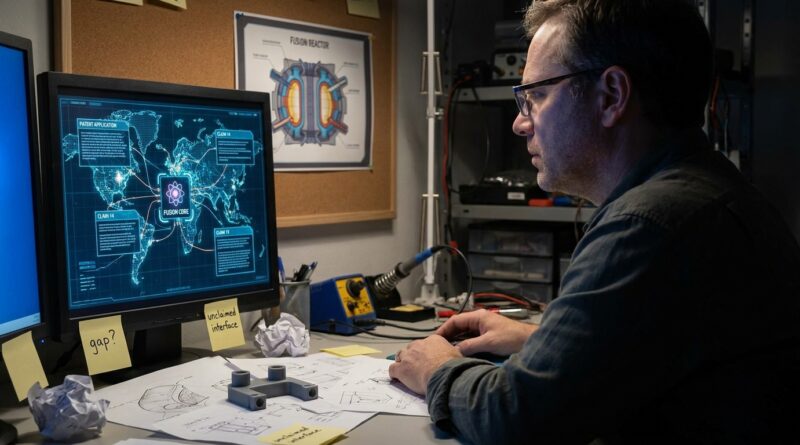
But that is not the only way to read it. For anyone watching fusion energy patent filings 2026, this is also a giant public clue. It tells you the land grab is happening now, not someday. More important, it gives you a live map of where attention is going, where engineering pain points are hiding, and where a solo inventor might still claim useful ground. The trick is to stop seeing a 100-filing portfolio as a wall, and start seeing it as a scouting report.
⚡ In a Hurry? Key Takeaways
- American Fusion’s 100 pending filings signal that hard-tech patent races are active right now, even in fusion.
- Solo inventors should read big patent portfolios like roadmaps, then hunt for side-problems, tooling, safety, maintenance, and measurement gaps.
- A giant filing spree does not mean every useful idea is taken. It means you need to search carefully and claim narrowly but clearly.
What happened, and why it matters
American Fusion Inc. says it has reached 100 patent applications pending tied to its Texatron fusion engine. The company also filed 17 additional US patents in a single push. That is a serious filing pace for a frontier energy company.
The easy reaction is, “Well, there goes any chance for small inventors.” I get it. If you are working alone or with one partner, 100 filings sounds impossible to compete with.
But big numbers tell a different story too. They show that hard-tech intellectual property is not dead, frozen, or reserved only for software-style companies. People are planting flags in difficult physical systems right now. That matters because many inventors still assume the patent action is mostly in apps, AI features, and cloud tools.
It is not. If anything, deep engineering categories often create more side-problems than software does, because every bold breakthrough depends on heat, materials, seals, sensors, cooling, power handling, maintenance, controls, and failure recovery.
What 100 filings really signal to solo inventors
1. The window is open now
If a company is stacking filings around fusion systems in 2026, that means the land is being divided up now. Not after commercialization. Not after the first perfect reactor. Right now, during the messy stage.
That is useful news. It means early, imperfect, supporting inventions still matter.
2. Big portfolios leave breadcrumbs
A filing spree usually clusters around recurring technical headaches. If you read enough of the applications, patterns pop out. You start seeing repeated concern around containment, power transfer, chamber geometry, fuel handling, thermal control, diagnostics, shielding, or startup sequences.
Those repeated themes are clues. They tell you where money and engineering hours are being burned.
3. Not every valuable invention is the “main engine”
This is the part solo inventors often miss. You do not need to invent the entire fusion reactor. You might invent a more durable inspection port, a calibration method for a sensor in extreme environments, a replaceable cooling interface, a fault-detection routine tied to physical hardware, or a manufacturing fixture that cuts alignment errors.
Those are not glamorous ideas. They can still be patentable and commercially useful.
How to use one company’s portfolio as a terrain map
Think of a large patent family like a map with bright circles around the areas a company cares about most. Your job is not to barge into the center of those circles. Your job is to study the edges.
Start with the abstracts and titles
You do not need to be a plasma physicist on day one. Read titles, abstracts, and representative drawings first. Make a simple list of recurring topics.
For example:
- Core reactor structure
- Fuel injection or handling
- Magnetic or electric field management
- Heat extraction
- Control systems
- Safety systems
- Maintenance and replaceable components
Once you group the filings, you can see where density is highest. High density means that area is crowded. It also often means nearby support problems are worth studying.
Then read the claims, not just the press release
Press releases tell you the dream. Claims tell you the fence line.
Look for what is actually being claimed. Is the company claiming a specific geometry, sequence, material range, control method, subsystem arrangement, or diagnostic approach? Good. Now ask the question most people skip: what are they not claiming?
That is where solo inventors can find daylight.
Look for repeated pain
If several filings keep returning to startup stability, thermal management, component wear, or signal noise, that usually means those problems are stubborn. Stubborn problems spawn practical inventions.
And practical inventions are often easier for a small inventor to prototype, describe, and file.
Where solo inventors should hunt for openings
Support equipment
Big companies often focus claims on the core machine. That leaves room in nearby tools.
- Alignment rigs
- Service carts
- Diagnostic adapters
- Specialized connectors
- Cooling or shielding accessories
Monitoring and measurement
Any extreme-energy system needs reliable measurement. If sensing is hard, there may be room for novel probe housings, calibration methods, placement systems, error correction tied to hardware limits, or safer inspection setups.
Maintenance and replaceability
Frontier machines break, drift, overheat, and need servicing. A replaceable cartridge, quicker seal design, contamination control method, or component swap process can be commercially meaningful even if it never gets a magazine cover.
Safety and shutdown systems
This is a big one. As systems become more powerful and more regulated, safety hardware and fault isolation become more valuable. Inventors who think in terms of “what happens when this goes wrong?” often find solid filing opportunities.
Manufacturing methods
Even if a company has protected its end device, it may not have fully covered how to make parts more precisely, cheaply, or repeatably. Manufacturing patents are not flashy, but they can be very strong.
A simple 5-step scouting exercise for your next provisional
Step 1: Build a patent theme sheet
Pick one company, here that would be American Fusion, and list 10 to 20 published applications or related records if available. Make a one-page sheet with themes and repeated terms.
Step 2: Mark the crowded zones
Circle topics with lots of overlap. Those are likely defended areas. Do not ignore them, but do not assume you should file straight into the center without a very clear distinction.
Step 3: List the side-problems
For each crowded zone, write down three support problems. Example: if thermal management is crowded, side-problems might be inspection access, replaceable heat interfaces, contamination-resistant channels, or thermal sensor mounting.
Step 4: Match to your actual skill set
Be honest here. If you are better at mechanical design than plasma theory, hunt in fixtures, chambers, couplings, flow paths, housings, or service procedures. If you are better at electronics, look at rugged instrumentation and fault handling.
Step 5: Draft a narrow provisional
Do not try to patent “fusion.” Patent your actual contribution. Be specific. Show the structure, method, use case, and why it solves a real problem better than current options.
Why this matters beyond fusion
This pattern is showing up in other hard-tech fields too. If you have noticed mixed signals in chips and energy hardware, you are seeing the same thing many inventors are. A useful companion read is Semiconductor Patents Are Quietly Surging: How Solo Inventors Can Slip Into the Next Chip Boom Before Big Tech Notices. The lesson is similar. Big filing numbers do not only mean competition. They also reveal where future supply chains, tools, and support products may be needed.
What not to do
Do not assume “100 patents” means “everything is taken”
Patent counts can sound bigger than they are. Some filings cover variations of a theme. Some may never issue. Some claims will be narrowed. Some areas may still be open around adjacent uses and support systems.
Do not skip the search
Hope is not a patent strategy. Before spending money, search published applications, issued patents, and non-patent literature. You want to know the neighborhood before you build in it.
Do not draft too broadly
A lot of solo inventors blow their first shot by writing giant wish-list provisionals. Better to file a clear, well-described, narrower invention than a vague “system for improving fusion performance” document that says almost nothing useful.
At a Glance: Comparison
| Feature/Aspect | Details | Verdict |
|---|---|---|
| 100 pending fusion filings | Shows active patent staking in hard tech, not a wait-and-see market | Important signal that filing windows are open now |
| Solo inventor opportunity | Best odds are often in side-problems, tooling, safety, diagnostics, and maintenance | Still viable if you search carefully and claim a real niche |
| Using big portfolios as research | Read titles, abstracts, drawings, and claims to spot patterns and gaps | One of the cheapest and smartest scouting methods available |
Conclusion
American Fusion Inc. just announced it has 100 patent applications pending around its Texatron fusion engine, after filing 17 more US patents in a single batch. That headline can either scare you off or sharpen your thinking. The better choice is the second one. A concentrated filing burst in a frontier field says two very clear things. First, hard-tech territory is being claimed right now, not later. Second, solo inventors do not need a giant lab or a 50-person IP team to take part if they treat these mega-portfolios as free roadmaps instead of reasons to quit.
Read the filings like a terrain map. Spot the crowded peaks. Then go looking for the smaller but useful valleys nearby, the side-problems that still need solving and still have commercial value. That is how news about someone else’s 100 patents can turn into the starting point for your next provisional.