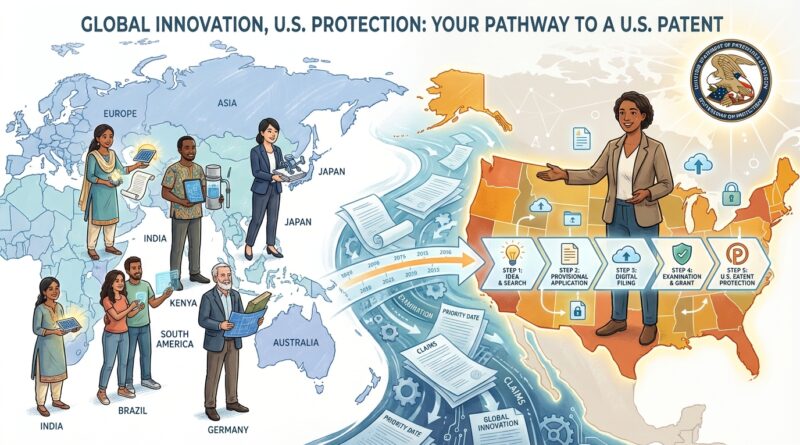
New USPTO Rule Just Raised The Bar For Foreign Filers: What Solo Inventors Need To Change Before They File in the U.S.
If you are an inventor outside the U.S., this kind of rule change is exactly the sort of thing that can ruin a carefully planned filing budget. You think you can file now, sort out the lawyer later, and keep costs down. That used to be a common assumption. Now it is a risky one. Under the new USPTO foreign applicant U.S. patent practitioner rule 2026, foreign-domiciled applicants generally need a U.S.-licensed patent attorney or patent agent to represent them before the USPTO. In plain English, if your permanent residence or principal place of business is outside the United States, the USPTO wants a qualified U.S. practitioner involved from the start for most direct dealings. Get this wrong and your application may not move forward the way you expect. The good news is that this does not mean your U.S. patent plans are dead. It means you need a smarter filing plan, a cleaner budget, and better timing before you press submit.
⚡ In a Hurry? Key Takeaways
- If you are a foreign-domiciled applicant, you should assume a U.S.-licensed patent practitioner is now required for USPTO representation.
- Pick U.S. counsel before filing, then prepare your claims, inventor details, and priority documents so you do not pay twice for avoidable fixes.
- This is not just paperwork. A misstep can delay examination, trigger extra cost, or force a messy refiling strategy.
What actually changed
The heart of the change is simple. The USPTO has raised the bar for who can act in front of the office on behalf of foreign applicants. If you are foreign-domiciled, the office now expects a U.S.-licensed patent practitioner to handle representation.
That means a U.S. patent attorney or a registered U.S. patent agent. Not a local filing service. Not a foreign patent consultant acting alone. Not a founder trying to figure it out through forms and guesswork.
The reason is not hard to understand. The USPTO wants clearer accountability, better compliance, and fewer filings that fall apart because nobody handling them is actually authorized to practice before the office. For solo inventors, though, the practical effect is more cost up front and less room to improvise.
Who counts as a foreign applicant
This catches more people than you might think. It is not just about citizenship. The key idea is domicile. If your permanent legal residence or principal place of business is outside the U.S., you are usually treated as foreign-domiciled for this purpose.
So if you are:
- a solo inventor living in India, Brazil, Germany, Nigeria, or anywhere else outside the U.S.
- a startup incorporated abroad with no true U.S. principal place of business
- a founder temporarily visiting the U.S. but actually based elsewhere
you should assume this rule applies unless your U.S. practitioner tells you otherwise.
Why this matters more than it sounds
On paper, needing U.S. counsel may sound like a formality. In real life, it changes your filing strategy.
You can no longer treat U.S. counsel as a later upgrade
Many non-U.S. founders used to think like this: file first, save money, then hire a U.S. attorney once the case gets serious. That approach is now much harder to pull off safely.
If counsel has to step in from the beginning anyway, you want that person shaping the application before it is filed, not after the damage is done.
Bad drafting gets expensive fast
A weak first draft often leads to extra office actions, narrower claims, or a full rewrite. If your U.S. practitioner has to rebuild a rushed application, your “cheap” first filing may end up costing more than a careful one.
Deadlines do not get kinder just because the rule changed
Priority windows, PCT national phase timing, signatures, declarations, and formal drawings still need to line up. The new rule does not create more flexibility. It makes planning more important.
What solo inventors should do before they file
1. Choose your U.S. practitioner first, not last
This is now step one. Interview a small shortlist. Ask whether they regularly handle foreign-origin applications, PCT national phase entries, and startup budgets. You do not need the fanciest firm. You need somebody competent, responsive, and realistic about cost.
Ask direct questions:
- Do you handle direct U.S. filings and PCT national phase entries?
- Will you review my claims before filing?
- What parts can I prepare myself to save money?
- What will likely need correction to meet U.S. practice?
- Can you quote filing-stage costs separately from later prosecution costs?
2. Get your invention summary in U.S.-friendly shape
Even before you hire counsel, prepare a clean invention package. This helps your practitioner work faster and keeps your bill lower.
Your package should include:
- a plain-language summary of the problem and your solution
- drawings or diagrams, even rough ones
- the best version of your claims or claim ideas
- examples, use cases, and alternative versions
- known prior art or competing products
- dates of disclosure, sales, offers, crowdfunding, or public demos
The more complete this is, the less time your attorney spends extracting basic facts.
3. Stop thinking only about filing fees
This is where many inventors trip up. They compare only the government fee or the cheapest drafting quote. That is not the real cost.
The real cost includes:
- attorney review and representation
- claim rewriting
- formal corrections
- priority document handling
- responses to USPTO notices
- future office action replies
A slightly more expensive but cleaner filing often wins.
4. Use PCT timing wisely if you need breathing room
For many non-U.S. inventors, the PCT route may become even more useful. It can buy time, help coordinate multi-country plans, and let you spread legal spend more intelligently.
That does not make the U.S. practitioner issue disappear. It just gives you a better runway to prepare for it.
If you know the U.S. is a target market but money is tight today, speak with counsel about whether your current stage calls for:
- a direct U.S. filing now
- a home-country priority filing first
- a PCT application to preserve options
- staged drafting with U.S.-style claims prepared early
The hidden trap: local drafting that does not translate well to U.S. practice
This is a big one. Patent applications written for one country do not always slide neatly into U.S. examination. Claim style, support requirements, terminology, and amendment room can all differ.
That means the cheapest first draft from your local market may not be the cheapest overall if your U.S. practitioner has to rebuild the claims later.
For that reason, one of the smartest moves now is to front-load U.S.-style claim drafting while fees are still under your control. Spend a bit more effort early. Save yourself a bigger bill later.
Common mistakes that can stall a U.S. filing
Here are the errors I would worry about most if I were advising a solo inventor over coffee.
Hiring a non-U.S. adviser to act beyond their lane
Your local patent professional may be excellent in your home jurisdiction. That does not mean they can represent you before the USPTO. Those are different things.
Submitting a rushed provisional and assuming it is “good enough”
A weak provisional can create a false sense of safety. If the disclosure is thin, missing variations, or badly drafted, you may not get the priority benefit you expected.
Waiting too long to tell counsel about public disclosure
If you showed the invention publicly, sold it, pitched it without protection, or posted details online, tell your U.S. practitioner immediately. Do not try to tidy up the story first.
Underestimating the paperwork
Entity details, inventor names, assignments, priority claims, declarations, and translations all matter. A tiny mismatch can create a headache later.
A practical filing playbook for 2026
If you want a simple plan under the USPTO foreign applicant U.S. patent practitioner rule 2026, use this checklist.
- Confirm whether you are foreign-domiciled.
- Choose a U.S.-licensed patent attorney or patent agent early.
- Prepare a full invention brief with drawings and claim ideas.
- Gather all filing dates, disclosure dates, and priority materials.
- Ask whether direct U.S. filing or PCT timing makes more sense.
- Get a cost estimate for filing stage and for later prosecution.
- Have your practitioner review the application before anything is filed.
- Do not assume you can fix a weak filing cheaply later.
Is this bad news for small inventors?
Honestly, it is mixed news.
Yes, it raises the cost of entry for foreign solo inventors and small startups. There is no point pretending otherwise. If you hoped to keep the U.S. process on a shoestring until later, this closes some of that wiggle room.
But there is another side. It may also reduce the number of badly handled applications that burn money and never become useful rights. For many inventors, being forced to get proper U.S. guidance earlier may actually protect the value of the invention.
The key is to treat this as a planning problem, not a dead end.
At a Glance: Comparison
| Feature/Aspect | Details | Verdict |
|---|---|---|
| Foreign applicant filing path | Foreign-domiciled applicants should expect to need a U.S.-licensed patent practitioner for USPTO representation from the start. | Plan for counsel early |
| Budget strategy | Saving money by filing first and hiring later is now much riskier. Better to spend carefully on one solid practitioner and a stronger draft. | Front-load smart spending |
| Best timing option | Direct U.S. filing may suit some inventions, but PCT timing can help founders spread cost and prepare U.S.-style claims more carefully. | Choose based on runway, not guesswork |
Conclusion
This change is frustrating, especially if you are a non-U.S. inventor trying to protect a real idea on a limited budget. But it does not shut you out of the U.S. system. It just means the old “file now, fix it later” habit is no longer a safe bet. This helps the Patentop community today because many indie inventors, small startups and non‑U.S. founders still assume they can “file first, hire a U.S. lawyer later.” With the new USPTO representation rule now locking foreign applicants into U.S. counsel from the start, the real advantage shifts to those who pre-plan: tightening budgets around one competent practitioner, using PCT timing to batch filings, and front-loading U.S. style claim drafting while fees are still under your control. Do that, and you can keep moving toward a granted U.S. patent with fewer nasty surprises, less wasted money, and a much better shot at turning your idea into something real.