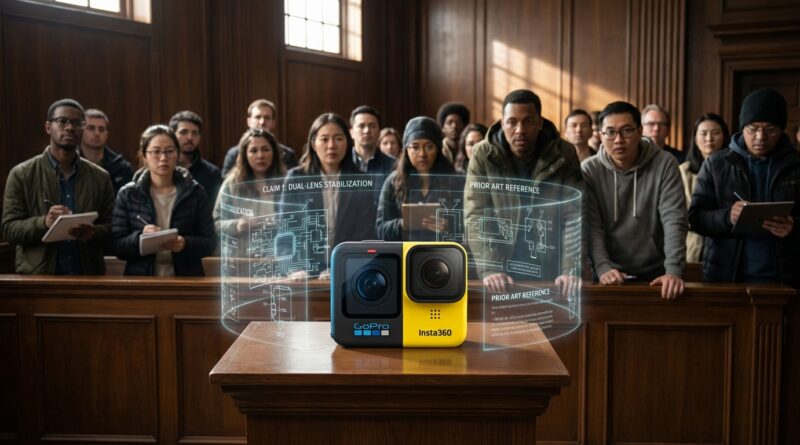
GoPro’s Patent Faceplant Just Rewrote Risk For Solo Hardware Inventors
If you are building a gadget on your own, this kind of news can feel brutal. You do everything “right.” You file patents, spend money on lawyers, and tell yourself that paperwork will protect the years you put into your idea. Then a case like GoPro versus Insta360 lands, and the message is hard to miss. Even a famous hardware company with a deep patent stack can spend nearly a decade fighting, end up with a reported $93.5 million hit, and still walk away with weakened ground. That is not just bad luck. It is a warning label for every inventor who thinks a patent, by itself, is a force field. The real lesson is not “patents are useless.” It is that weak claims, broad assumptions, and poor proof can turn a patent from shield into expense. If you are a solo inventor, this case is worth studying now, before your product ships and before a copycat shows up.
⚡ In a Hurry? Key Takeaways
- GoPro’s loss shows that even big patent portfolios can fail if claims are too broad, too weak, or hard to defend.
- Solo inventors should file narrower, better-supported claims and keep strong records of prototypes, testing, and first real-world use.
- A patent helps, but it is not enough on its own. You also need evidence, timing, a copycat plan, and a budget reality check.
What happened, in plain English
The GoPro Insta360 patent case lessons for inventors start with one uncomfortable fact. Patent fights are not won just because you own patents. They are won when those patents hold up under attack.
In this long-running fight, GoPro tried to use its patent portfolio against Insta360. But after years of legal combat, the result became a painful example of how litigation can boomerang. Reports around the latest outcome point to a major financial loss for GoPro and patents that did not end up looking nearly as strong as they may have seemed at the start.
For regular people, the easy mistake is thinking, “Well, that is big-company drama. It does not apply to me.” It absolutely does. In fact, small inventors have less room for mistakes because one bad filing or one expensive lawsuit can wipe out years of work.
Why this matters so much to solo hardware inventors
If GoPro can struggle with teams of lawyers, expert witnesses, and a shelf full of patents, a solo inventor cannot afford to be casual about patent strategy.
The danger is not only losing in court. The danger is building your whole business plan around the idea that a patent will save you later. That is where many inventors get hurt.
A patent is not a magic fence
Think of a patent less like a brick wall and more like a claim ticket. It gives you a legal basis to argue ownership of a specific invention. But the exact wording matters. The proof behind it matters. What existed before your filing matters. What your product actually does matters.
If those pieces are shaky, your patent can become very expensive paper.
Big portfolios can create false confidence
Companies often collect patents the way some people collect tools. The problem is that owning a lot of tools does not mean each one works well when you need it.
That is one of the clearest lessons here. A big portfolio can look impressive in a press release and still fall apart under close legal review.
The biggest lessons inventors should copy from this mess
1. Narrow and clear beats broad and vague
Many inventors want the broadest possible patent because they are scared of copycats designing around it. That fear is understandable. But broad claims are also easier targets.
If your wording tries to cover too much, an opponent can argue the patent should never have been granted in the first place, or that earlier products and publications already covered similar ground.
For solo inventors, a smart move is often this: claim the core thing you truly invented, in clear language, with practical detail. Do not try to own an entire category if what you really created is a specific mechanism, housing design, mount, sensor arrangement, cooling method, or user interaction.
2. Your notebook matters more than you think
If a fight ever starts, memories are weak. Documents are not.
Keep dated records of sketches, prototypes, test videos, engineering changes, supplier messages, and early demos. Save failed versions too. They can help show how your idea developed and what problems you solved.
This is boring work. It is also the kind of work that can save you later.
3. Real-world use can strengthen your position
Patents live in legal language, but disputes often get decided through real-world facts. Did your product actually solve the problem described? When did you first sell it? What features were in shipping units? How did customers use it?
The closer your patent story matches the real product story, the stronger your position usually becomes.
4. Plan for the copycat before launch, not after
This is the lesson too many founders learn late. They launch first, then panic when a cheaper rival appears.
Before shipping, ask:
- What exact feature is hardest to copy?
- What part can I protect with a patent?
- What part is better protected as a trade secret?
- What proof do I need if someone copies me?
- Can I afford enforcement if it comes to that?
If the answer to the last question is no, that does not mean you should quit. It means your business moat may need to include brand, speed, manufacturing quality, customer trust, and software support, not just patents.
Patterns to avoid if you do not want your patent to backfire
Filing too early with half-formed ideas
Inventors rush because they are scared someone else will beat them. Sometimes speed matters. But a rushed filing can leave out the very details that make your invention defensible.
If your prototype is still changing every week, you may need a more careful filing plan, not just a fast one.
Writing claims that sound strong but prove little
Fancy legal wording can create false comfort. Good patent claims are not impressive because they sound complex. They are impressive because they are specific, grounded, and hard to knock down.
Thinking the patent ends the job
The filing is the start of the protection work, not the end. You still need product evidence, sales records, clear dates, competitor monitoring, and a plan for what you will do if someone copies you.
Picking a fight you cannot fund
This one is harsh, but it is real. A patent only has practical value if you can do something with it. That does not always mean a courtroom battle. Sometimes it means sending a strong letter, negotiating a license, or using the patent to make partners take you seriously.
But if your only plan is “I will sue them,” and you have no money to sue them, that is not a plan.
What a smarter patent strategy looks like for a solo inventor
Start with the product, not the fantasy
Write down what makes your gadget actually different. Not in marketing language. In plain English.
- What exact problem does it solve?
- What physical feature solves it?
- What would a knockoff likely copy first?
- What workarounds might competitors try?
That exercise often reveals what is worth patenting and what is not.
Use layered protection
The best protection is often a mix:
- Patent the core technical feature
- Keep manufacturing know-how private where possible
- Use design protection for appearance if relevant
- Build a brand people trust
- Create software, service, or accessory lock-in if it makes sense
A single patent is fragile. A layered approach is tougher.
Budget for defense before you need it
You do not need a giant legal war chest. But you should know, in advance, what you can afford.
That might mean setting aside money for:
- a prior art search
- a careful patent draft
- a second opinion on claim strength
- a cease-and-desist letter
- basic monitoring of competitors
That is much cheaper than finding out, years later, that your “protection” is weak.
The uncomfortable truth this case exposed
Patents can be useful. They can attract investors, scare off lazy copycats, help in licensing talks, and create real legal rights. But they are not self-enforcing, and they are not automatically strong just because the patent office issued them.
That is the heart of the GoPro Insta360 patent case lessons for inventors. The real risk is not only theft of your idea. It is overestimating how much your patent can do when challenged by a determined opponent.
For solo builders, humility is not weakness here. It is strategy. Assume your claims will be tested. Assume a rival will look for loopholes. Assume that if a case ever happens, every vague sentence and every missing record will matter.
What to do this week if you already have a gadget in development
- Review your patent or draft application in plain English. Can you explain what it protects in two sentences?
- Gather dated proof of development, prototypes, and test results in one place.
- List the top three features a copycat would steal first.
- Ask a patent attorney where your claims are strongest and where they are exposed.
- Build a backup moat through quality, support, branding, and speed to market.
If that list feels annoying, good. It means you are looking at the real work, not just the comforting story that a patent solves everything.
At a Glance: Comparison
| Feature/Aspect | Details | Verdict |
|---|---|---|
| Broad patent claims | Can look powerful at first, but are easier to attack if prior art or vague language exists. | Risky for solo inventors unless tightly supported. |
| Strong documentation | Dated sketches, prototypes, test logs, and sales history help prove what you built and when. | Essential and relatively low-cost. |
| Patent-only strategy | Relies too much on legal enforcement and ignores branding, execution, and trade secrets. | Weak safety net on its own. |
Conclusion
The GoPro loss is not just headline drama. It is a live case study in how aggressive, over-broad, or poorly defended patents can backfire right when you think they are your safety net. The useful takeaway is not to fear patents. It is to treat them with more care and less fantasy. If you tighten your claims, document real-world use, and plan for copycats before you ship, you give yourself a much better shot than inventors who wait until the fight starts. That is the real value here. Learn from the expensive mistakes of bigger players now, while your product is still small enough to protect smartly.