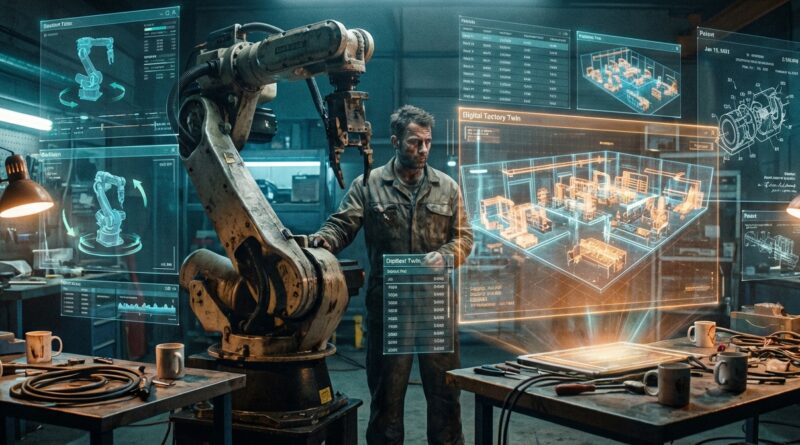
Digital Twin Patents Just Exploded: How Garage Inventors Can Cash In On The Virtual Factory Boom
You can see why garage inventors feel shut out here. “Digital twin” sounds like a boardroom phrase, the kind of thing only giant factories, aerospace firms, and software vendors get to own. That is the myth. The real story is much more useful, and a lot more urgent. Patent filings around digital twins have jumped fast in just a few years, rising by several hundred percent and pushing past two thousand applications in a recent year. That matters because this is not just about flashy virtual models. It is about practical systems that predict machine failures, tune production lines, mirror vehicle fleets, and connect physical equipment to software in ways companies will pay for. Better still, some big players appear to be slowing or shifting budgets, especially with the USPTO seeing a dip while other offices report record filing activity. For solo inventors, that creates a rare opening. Not to own “digital twins” as a whole, but to claim a sharp, specific piece of the puzzle.
⚡ In a Hurry? Key Takeaways
- Digital twin patent trends 2026 show a busy and growing field, but small inventors still have room in narrow, practical use cases.
- Focus your patent on a specific problem, like maintenance prediction, process optimization, or a physical-to-digital interface, not on vague “smart factory” language.
- If your idea depends on real-world inputs, measurable outputs, and a clear industrial benefit, it has a better shot at standing out and surviving review.
Why this quiet patent rush matters
Most people hear “digital twin” and picture a fancy 3D model on a giant screen. That is only part of it.
A digital twin is usually a live software model tied to a real machine, process, vehicle, building, or system. It updates using sensor data, historical data, control settings, and sometimes simulation tools. The point is not just to watch something. The point is to predict, improve, or control it.
That is why patent activity is rising. Once companies realized these twins can cut downtime, improve throughput, reduce waste, and test changes before touching the real system, the filing race started.
And now we are at an awkward moment that can actually help independent inventors. The space is heating up. But many filings are broad, fuzzy, and packed with generic “digitalization” wording. That leaves room for clear, useful inventions that solve one real industrial problem well.
What the digital twin patent trends 2026 are really telling us
The headline is simple. More people are filing. More industries are joining in. And the ideas are becoming more concrete.
Where growth is strongest
Manufacturing is still the obvious center of gravity. Virtual factories, line balancing, robotic cell monitoring, and machine health models are all busy patent areas.
But it is not just factory floors. Energy companies are filing around grid assets, wind turbines, battery systems, and plant maintenance. Logistics players are moving into fleet twins, warehouse flow twins, and shipment condition tracking. Infrastructure is growing too, with bridges, water systems, rail, and ports all becoming candidates for digital mirroring.
Why timing matters now
One interesting twist is the gap between offices. Some major patent offices are reporting record overall filings, while the USPTO has seen a notable dip. That does not mean innovation stopped. It often means budgets are being moved around, portfolios are being trimmed, or applicants are filing more selectively.
For a solo inventor, that can be good news. If larger incumbents are pausing, narrowing, or spreading their filings globally, there may be open space in targeted US claims or in specialized subfields they have not covered cleanly.
The mistake small inventors keep making
They try to patent the whole concept.
You cannot stroll in and say, “I invented a digital twin for factories.” That is too broad, too late, and too easy to challenge.
What you can do is patent a specific method that makes a digital twin more useful, more accurate, cheaper, safer, or easier to connect to real equipment.
Weak framing
“A system for digitally representing an industrial machine and improving operations.”
Stronger framing
“A method for predicting bearing failure in variable-speed conveyor motors using a hybrid digital twin that combines vibration data, maintenance logs, and dynamic load-state simulation.”
See the difference? The second one has teeth. It names a real setting, a real function, and a real technical path.
Where garage inventors can still win
You are not likely to beat Siemens or GE in broad platform claims. You do not need to.
Look for smaller wedges inside the bigger boom.
1. Maintenance prediction for ignored equipment
Everyone wants predictive maintenance. But many systems still focus on expensive headline equipment. There is room in overlooked gear, things like pumps, valves, conveyors, small motors, compressors, packaging units, and mobile service equipment.
If you can create a twin model that works with low-cost sensors, sparse maintenance records, or noisy field conditions, that is useful.
2. Process optimization for messy real-world operations
Many factories do not run under perfect lab conditions. They deal with operator variability, supply changes, dirty environments, and old machines bolted to newer software.
A digital twin that helps optimize process timing, material flow, energy use, or changeover scheduling in those mixed environments can be very patentable if the method is specific.
3. Hybrid physical-digital interfaces
This is a promising lane. Think operator tools, retrofit sensor mounts, calibration devices, AR overlays, control handoff systems, or modules that sync a physical asset with its virtual model without a full rip-and-replace setup.
Big vendors often chase software-heavy claims. Small inventors can do well where hardware, workflow, and software meet.
4. Digital twins for niche fleets
Not every fleet is trucks or airplanes. There are forklifts, yard tractors, farm equipment, service vans, rental tools, cold-chain containers, and autonomous carts inside warehouses. If you know one of these worlds well, you may spot pain points outsiders miss.
How to tell if your idea is actually patent-worthy
Here is the plain-English test.
Your idea is stronger if it answers these questions clearly:
- What physical thing or process is being mirrored?
- What data enters the twin?
- What model or method transforms that data?
- What result comes out, prediction, control change, scheduling advice, failure alert, energy adjustment?
- Why is that result better than existing methods?
If your answer is mostly buzzwords, stop and tighten it.
Good signs
Measured inputs. Defined outputs. A narrow industrial setting. A technical improvement. A way to show benefit.
Bad signs
Generic dashboards. “AI-powered optimization” with no operational detail. Claims that read like a slide deck. Anything that could apply to every machine everywhere.
How to frame the invention so it does not disappear into vague claims
This is where a lot of smart people lose the thread.
Digital twin applications often get buried in language like “digital transformation,” “smart operations,” or “virtualized assets.” That sounds modern, but it does not help much when you are trying to show novelty.
Instead, frame your invention around the mechanism and the industrial result.
Use this structure
Physical asset or process: What real thing are you modeling?
Data pipeline: What sensor, event, maintenance, or environmental data do you use?
Twin logic: What simulation, rules, estimation, synchronization, or prediction method do you apply?
Operational outcome: What happens better because of it?
For example, not “a digital twin for warehouse optimization.”
Better: “a synchronization method for updating a warehouse vehicle twin using battery state, route congestion, and payload weight to reduce failed task assignments.”
Simple research habits that can save you time and money
You do not need a giant legal team to start smart. You do need discipline.
Search by use case, not just by buzzword
Look up terms tied to your problem, not only “digital twin.” Search phrases around predictive maintenance, industrial simulation, asset synchronization, machine state estimation, virtual commissioning, fleet mirroring, process control, and human-machine interfaces.
Read patents from the edges of your field
Your best clue may come from adjacent industries. A method used in aviation maintenance may inspire a version for food processing. A warehouse twin claim may reveal language useful for a port or rail application.
Track what is crowded
Some areas are getting noisy fast, especially broad smart factory monitoring claims and generic maintenance dashboards. If a lane feels stuffed with large vendors, move one layer down to a narrower task, a retrofit scenario, or a niche piece of equipment.
Three practical claim angles small inventors should consider
Method claims
These often work well when your novelty is in the sequence of collecting, syncing, modeling, and acting on data.
System claims
Useful if your invention depends on how sensors, controllers, software modules, and interfaces are arranged together.
Interface or hardware-linked claims
Strong when your idea includes a physical adapter, calibration approach, retrofit unit, or operator-facing tool that makes the twin function in the real world.
If you can support all three, even better. You create more ways to protect the same core idea.
The commercial angle inventors should not ignore
A patent is not a trophy. It is a business tool.
Ask yourself who would pay for your idea first. A plant manager? An OEM? A maintenance contractor? A warehouse operator? An energy asset owner?
The best digital twin inventions often save money in boring but painful places. Fewer breakdowns. Better uptime. Lower scrap. Faster changeovers. Better asset life. Simpler compliance records.
That is good news for solo inventors because buyers often care more about solved pain than about flashy branding.
At a Glance: Comparison
| Feature/Aspect | Details | Verdict |
|---|---|---|
| Broad platform idea | Claims a general digital twin for factories, fleets, or infrastructure with little technical detail | High competition, weaker for solo inventors |
| Narrow industrial use case | Targets one problem such as maintenance prediction, line tuning, or fleet state synchronization | Best opening for a small filer |
| Hybrid physical-digital solution | Combines sensors, retrofit hardware, operator workflow, and software modeling | Often practical, defensible, and commercially attractive |
Conclusion
The big takeaway from digital twin patent trends 2026 is not that small inventors are too late. It is that the map is finally getting clear. In the last few years, digital twin patent filings have surged by several hundred percent, with more than two thousand applications in a single recent year and steady growth across manufacturing, energy, and logistics. At the same time, major patent offices are seeing record overall filings while the USPTO has posted a noticeable dip, suggesting some incumbents are slowing down or moving budget just as virtual factory, fleet, and infrastructure ideas become more urgent and more patentable. That creates a narrow but real window. The crowded ground is broad, fuzzy “digitalization” talk. The better opening is in specific, useful inventions such as maintenance prediction, process optimization, and hybrid physical-digital interfaces. If you can define the asset, the data, the twin logic, and the measurable result, you are not too small for this boom. You may be early enough to matter.