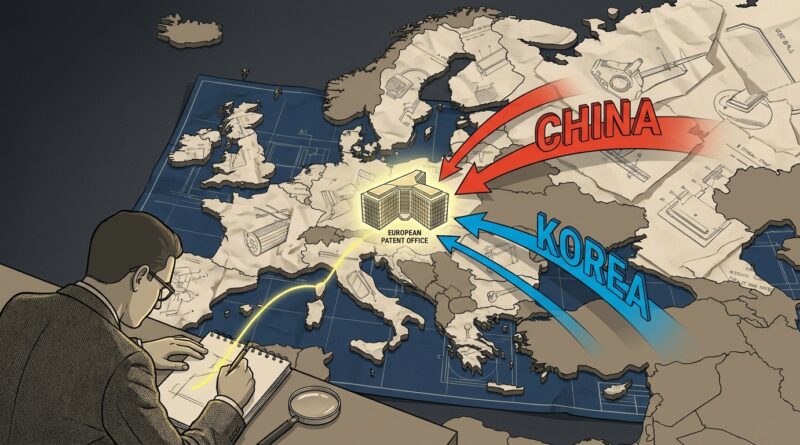
China And Korea Just Surged At The EPO: How Small Inventors Can Still Carve Out Space In Europe
If you are a solo inventor or running a tiny startup, the latest European patent numbers can feel a bit brutal. You spend months getting one idea into shape, then you look up and see China and South Korea filing into Europe at roughly ten percent annual growth, especially in crowded areas like AI, batteries, and next-gen telecoms. That is enough to make anyone wonder if there is any room left. The good news is yes, there is. But Europe is no longer a sleepy side market where you can file late and hope for the best. The European Patent Office just passed 200,000 applications in a year for the first time, and a lot of that extra pressure is coming from outside Europe. For small inventors, this changes the game. You are less likely to win by filing broadly. You are more likely to win by picking sharper claims, better timing, and technology spaces the big players still do not fully cover.
⚡ In a Hurry? Key Takeaways
- China patent surge at EPO what it means for small inventors: Europe is now more crowded, especially in AI, batteries, and wireless tech, so small filers need tighter strategy.
- File with precision, not ego. Focus on narrow, defensible claims and market-specific inventions instead of trying to cover everything.
- Do not assume “small” means “too late.” Many crowded sectors still have gaps in niche applications, tooling, manufacturing methods, and industry-specific uses.
Why these new EPO numbers matter
The headline figure is simple. European patent applications have topped 200,000 for the first time. That alone tells you competition is rising. But the more important detail is where the growth is coming from.
China and South Korea are increasing their presence fast. And they are not spreading filings evenly across every category. They are piling into areas that already attract heavy spending and big-company attention. Think AI systems, electric battery technology, semiconductors, telecoms, and connected devices.
If you are a small inventor, that does not mean Europe is closed. It means the easy parts are gone. You cannot treat a European filing like an afterthought anymore.
What is really happening behind the surge
Large Asian applicants are doing what large applicants do best. They file consistently, they file internationally, and they build thickets around technologies they expect to matter for years. Europe is attractive because it is wealthy, regulated, and commercially important. A granted European patent can still be a serious business tool.
So the rise in filings is not random noise. It is a sign that Europe is being treated as a primary battleground.
The crowded zones
The fastest pressure is showing up in a few familiar places:
- AI models and applied AI systems
- Battery chemistry, battery safety, charging, and pack design
- 6G and advanced wireless communication
- Chips, sensors, and embedded electronics
- Smart manufacturing and industrial automation
If your idea sits right in the middle of one of those spaces, you need to assume there are many more prior art documents than there were a few years ago.
The less obvious spillover
Here is the part many people miss. When filing activity spikes in one hot area, the pressure spreads outward. A battery filing boom also affects thermal management, materials testing, safety enclosures, charging diagnostics, and recycling methods. An AI filing wave can touch healthcare tools, legal software, logistics, education platforms, and factory systems.
That means even if you are not building “core AI,” you still need to search carefully before you file.
So, is this bad news for small inventors?
Not entirely. It is bad news for vague inventions, broad wish-list claims, and last-minute filing plans. It is not bad news for focused inventors who understand where big companies are weak.
Large filers often leave gaps because they optimize for scale. They want broad platform coverage and large market categories. They are not always great at protecting small but valuable use cases, regional compliance tweaks, niche workflows, or specialist hardware-software combinations that solve a narrow real-world problem.
That is where smaller applicants can still carve out space.
Where small inventors can still find daylight
1. Industry-specific applications
Big patent portfolios often describe a general system. They may not go deep into how that system works in one stubborn, regulated, messy industry. If you can show how a technology solves a concrete problem in food processing, maritime systems, elder care, recycling, or small-scale manufacturing, that can be valuable.
2. Tools around the main invention
Everyone rushes to patent the star product. Fewer people protect the setup, calibration, maintenance, testing, packaging, or fail-safe process around it. Those surrounding pieces can be easier to defend and easier to license.
3. Local compliance and European fit
A lot of foreign filings aim for broad market coverage. They may not be tuned to specific European technical standards, environmental rules, or workflow habits. If your invention fits a European customer pain point neatly, that can matter.
4. Better timing
Small inventors often lose because they wait too long. In a rising filing environment, delay is expensive. A fast, well-prepared priority filing can protect your place before a crowded category gets even tighter.
What “precision, not volume” looks like in practice
This is the part that matters most. If the EPO is getting more crowded, you should not respond by pretending to be a giant company. You probably cannot out-file a multinational. You can out-think one.
Start with a sharper patent search
Do not just search keywords from your own product page. Search by problem solved, component names, likely competitor language, and adjacent industries. A weak prior art search leads to expensive false confidence.
Write claims around the real novelty
Many small applicants waste money claiming the whole castle when their actual novelty is the front door lock. Find the part that is truly new. Claim that clearly. Then build fallback positions around it.
Protect the commercial version, not just the lab version
Your first prototype might impress engineers. But the patent should also think about the version customers would buy. Include practical embodiments, implementation details, and use-case variations where they add support.
Pick countries carefully
Europe is not one cheap checkbox. Even with regional filing routes, the costs of validation, translation, maintenance, and enforcement can add up. File where you expect real business value, manufacturing risk, or licensing potential.
How to rethink filing routes into Europe
For many small teams, the instinct is to postpone Europe until the product is bigger. That was already risky. Now it is more risky.
You generally have a few strategic paths:
- File early nationally or provisionally elsewhere, then use that priority for a European route later.
- Use the PCT route if you need more time to test commercial interest before national or regional entry.
- Go directly to the EPO if Europe is central to your business plan and timing matters.
There is no single “best” route for everyone. The right choice depends on budget, speed, where you expect copycats, and whether your value comes from product sales, licensing, or acquisition.
The key shift is mental. Europe should no longer be treated as a quiet secondary market by default.
Common mistakes small inventors should avoid right now
Filing too broad, too early
Broad claims sound exciting, but if they are not supported well, they can collapse fast during examination. In crowded fields, examiners have plenty to cite against you.
Filing too narrow, too late
The opposite mistake is waiting until your product is fully polished and then filing a claim so narrow that competitors can walk around it. Balance matters.
Ignoring adjacent patent classes
Your invention may be classified somewhere unexpected. This happens a lot in software-enabled products, health tech, green tech, and industrial systems.
Assuming hot sectors are impossible
Crowded does not mean closed. It means your angle needs to be clearer. A niche battery diagnostic method or AI audit workflow may still have room even if “battery tech” or “AI” sounds saturated.
What the China and Korea rise should teach European and independent inventors
The biggest lesson is not just that foreign filings are increasing. It is that serious applicants move early and treat patents as part of market entry, not an optional paperwork exercise.
That mindset matters more than nationality. Small inventors who build a filing plan around product milestones, investor conversations, and likely infringement points will do better than inventors who file only when they feel nervous.
If your invention has a genuine edge, Europe can still be worth it. You just need to go in with your eyes open.
At a Glance: Comparison
| Feature/Aspect | Details | Verdict |
|---|---|---|
| EPO competition level | Applications have crossed 200,000, with strong growth from China and South Korea in key technology sectors. | Europe is now a crowded patent arena, not a quiet backup market. |
| Best strategy for small inventors | Focus on narrow novelty, niche industry fit, smart timing, and commercially meaningful claims. | Precision beats volume. |
| Opportunity despite the surge | Gaps still exist in specialist applications, support tools, compliance-driven features, and overlooked workflows. | There is still room, but you need a sharper map. |
Conclusion
The fresh data out of the EPO shows applications topping 200,000 for the first time, and a big share of that growth is coming from outside Europe, especially China and Korea. For independent inventors and small teams, this is the moment to adjust strategy. Stop thinking of Europe as a quiet secondary market and start treating it like a crowded arena where you win by precision, not volume. The smart move now is to identify where filings are clustering, spot the spaces they still leave open, and file in a way that matches your actual business goals. If you do that, the surge is not just a threat. It is a signal telling you where to aim next.