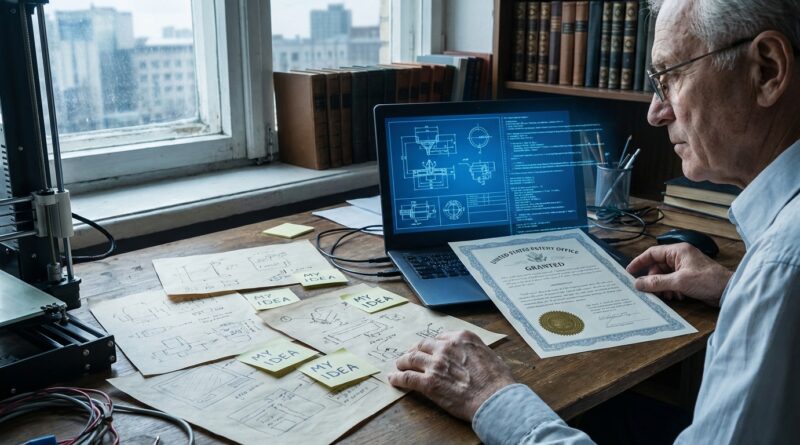
AI-Generated Inventions Just Got Real: What Solo Inventors Need To Know Before Letting Algorithms File First
You are not imagining it. Patent rules around AI-generated inventions really are moving under your feet, and that is especially rough if you are a solo inventor doing everything yourself. One day AI looks like a helpful co-pilot for brainstorming, drawings, and draft claims. The next day you are reading that if the invention sounds too machine-made, your patent could be in trouble before an examiner even gets to the good part. That is a nasty surprise. The good news is this is not a ban on using AI. It is a warning to be careful about how you use it, how you document it, and how you describe the invention. Right now, the safest path is simple. Make sure a real human can clearly explain the inventive idea, the choices made, and why those choices matter. If the AI helped, fine. If the AI did the inventing, that is where the filing starts to wobble.
⚡ In a Hurry? Key Takeaways
- Most patent offices still expect inventors to be human, even if AI was heavily used during development.
- Keep a written record of your prompts, edits, design choices, testing, and why you selected one output over another.
- Avoid describing the AI as the “inventor” or the invention as “autonomously generated” unless you want extra trouble.
The core issue is not whether you used AI
It is whether a human being can honestly claim the inventive contribution.
That sounds like lawyer talk, but the idea is pretty practical. Patent systems were built around human inventors. So when an application says, or even suggests, that the machine came up with the key inventive concept on its own, alarms go off.
For solo inventors, this matters a lot because AI tools are now baked into the normal workflow. You might use one to sketch alternatives, clean up technical writing, suggest materials, or draft claims. None of that automatically kills a patent. What matters is who recognized the problem, set the goal, judged the outputs, made the final inventive choices, and turned rough machine output into a real solution.
Why patent offices are getting nervous
Patent offices around the world are trying to update old rules for a new reality. They know AI can help produce useful technical ideas fast. They also know the law in many places still assumes inventorship is tied to a person.
That creates an awkward gap. The tools are modern. The legal framework is often not.
Big companies can deal with this by having patent counsel shape the story from day one. Solo inventors usually do not have that luxury. They may use an AI tool casually, then later realize their notebook, email trail, and draft application make it look like the software did the heavy lifting.
That is the danger. Not just what happened, but what your filing appears to say happened.
What counts as human contribution?
Think of inventorship as more than typing a prompt and picking your favorite answer. In most cases, a human inventor should be able to point to meaningful intellectual input.
Strong signs of human inventorship
These usually help your position:
- You identified the technical problem to solve.
- You set meaningful design constraints, not just a vague request.
- You evaluated several outputs and rejected weak ones for technical reasons.
- You combined, modified, or improved AI suggestions into something new.
- You tested the result and made inventive changes based on what you learned.
- You wrote or refined the claims around the actual inventive concept you understood.
Weak signs that can cause trouble
These can make a filing look shaky:
- You asked the AI to “invent a new device” and mostly accepted what it gave you.
- You cannot explain why the final solution works or why it is different from prior art.
- Your notes show almost no human decision-making beyond copying output.
- Your application says the AI “autonomously created” the invention.
The words that can quietly wreck your filing
This is where many smart inventors trip. They are trying to sound modern and honest, but the phrasing creates a problem.
Be very careful with language like:
- “The AI inventor developed the concept.”
- “The invention was autonomously generated by our model.”
- “The system conceived the solution without human intervention.”
- “We let the algorithm invent first, then we filed it.”
Those lines may sound impressive in marketing. In a patent file, they can be poison.
A safer, more accurate way to describe things is closer to this:
- The inventor used AI-assisted tools to explore design options.
- The inventor defined the problem, constraints, and evaluation criteria.
- The inventor reviewed outputs, selected promising approaches, and made further inventive modifications.
- The inventor confirmed utility and reduced the concept to a workable form.
You are not hiding the AI. You are putting it in the right place. Tool, not inventor.
Your best defense is boring documentation
I know. “Keep better records” is not exciting advice. But it is exactly what can save you later.
If you are working on something you may patent, keep a simple invention log. It does not need to be fancy. A dated folder and a habit of saving versions will do more good than a grand system you never use.
What to save
- The original problem statement in your own words.
- The prompts you used.
- The outputs the AI gave you.
- Your comments on why some outputs were wrong or incomplete.
- Your changes, sketches, calculations, and experiments.
- Test results and why they led you to alter the design.
- The moment where the final inventive concept became clear to you.
If there is ever a challenge about who really invented what, that trail matters.
Think of AI like a clever intern, not a legal co-inventor
Here is the plain-English mental model I suggest. AI can be a very fast assistant. It can suggest, summarize, draft, compare, and remix. But the legal system in many places still wants a human mind at the center of invention.
If a bright intern gave you ten rough ideas and you chose one, fixed it, tested it, and turned it into a new solution, you would still understand how to explain your contribution. Use that same standard for AI.
If, on the other hand, you cannot really say what you contributed beyond “I asked for something novel,” pause before filing.
How to future-proof your patent specification
Because the rules are changing, your application should be written with tomorrow’s scrutiny in mind, not just today’s filing deadline.
1. Describe the technical problem clearly
Start with the problem you recognized. That helps show the invention begins with human insight, not random machine output.
2. Explain the inventive choices
Do not just present the final design. Explain why particular features were selected, combined, or modified. This is where your contribution becomes visible.
3. Include alternatives you considered
If you explored several paths and chose one for technical reasons, say so. That shows judgment, not button-pushing.
4. Avoid romantic AI language
Patent applications are not product launches. Skip the “self-inventing engine” talk. Save that for the pitch deck, if you must.
5. Be accurate about tool use
If AI helped with drafting, simulation, or idea generation, that is fine. But the specification should still tie the inventive concept to human contribution where that is truthful and supportable.
What solo inventors should do before filing
If you are close to filing, run through this checklist first:
- Can I explain the inventive concept in plain English without mentioning the AI first?
- Can I identify my own technical choices that shaped the invention?
- Do my notes show selection, modification, testing, or refinement by me?
- Does my draft avoid calling the AI an inventor?
- Would a skeptical examiner think I understood the invention, or just generated text about it?
If you are struggling with any of those, slow down. Better a delayed filing than one that is unpatentable on arrival.
A practical caution about AI drafting tools
More inventors are now using tools that promise to write claims, specs, and prior art summaries in minutes. That can save time, but it can also create two separate risks.
Risk one: inventorship confusion
If the tool appears to do the core thinking, your inventorship story gets messy fast.
Risk two: confidentiality and data exposure
If you paste your best unfiled idea into a black-box system, you need to know what happens next. Is it retained? Used for training? Visible to staff? Stored in another country? Those are not side issues. For patents, early disclosure mistakes can become very expensive.
So before you use any AI drafting service, check the terms, retention policy, and privacy settings. If the answer is fuzzy, assume the risk is real.
The big company playbook, translated for normal people
Large firms often do three simple things that solo inventors can copy.
- They document who did what.
- They review drafts for bad inventorship language.
- They separate AI assistance from human conception in their records.
You do not need a legal department to do that. You just need discipline.
Create a project folder. Keep dated notes. Save prompt history. Mark your own edits. Write one short summary after each work session saying what you decided and why. That alone puts you ahead of many rushed filers.
At a Glance: Comparison
| Feature/Aspect | Details | Verdict |
|---|---|---|
| Using AI for brainstorming | Generally safer if you defined the problem, judged the outputs, and developed the final solution yourself. | Usually acceptable with good records |
| Calling AI the inventor | Conflicts with how many patent systems currently view inventorship and can trigger rejection or disputes. | Avoid |
| Saving prompts and edits | Creates evidence of human contribution, technical judgment, and refinement over time. | Strongly recommended |
Conclusion
The rules around AI generated inventions patent filing rules for inventors are still shifting, and that uncertainty lands hardest on small filers who do not have an in-house legal team translating every policy update into practical steps. But the situation is not hopeless. You can still use AI tools without wrecking your patent chances. The trick is to treat AI as an assistant, not a magical inventor, and to keep a clear record of your own technical thinking, choices, and refinements. Be careful with your wording. Be honest about the role of the tool. And make sure your application shows a human mind at the center of the invention. That plain, careful approach gives you a much better shot at filing something sturdy, not something that falls apart the moment an examiner asks who really came up with the idea. As AI-assisted drafting becomes normal, having this kind of practical playbook is no longer optional. It is part of inventing responsibly.